Showing posts with label One Small Square. Show all posts

Friday, September 28, 2012

Puffballs!

I have always loved puffballs.

I don't think there's "too old" to have fun making puffs of "smoke" come out of a puffball. So when I spotted this patch of puffballs growing at the edge of the parking lot, a little childhood thrill went through my heart.


Puffballs, one of my favorite fungi (Photo credit (c) 2012 Kim Bennett)


What's a Puffball?

Puffballs are mushrooms that are shaped like a somewhat round "egg", that release their spores through a pore at the top of the "egg," when mature. They are attached to the ground by mycelium, as are the gilled mushrooms.

Puffballs can be confused with the immature forms of other mushrooms. However, when you slice the mushroom in half, a puffball will just be flesh (if immature, like this giant puffball my little guy whacked open on a nature walk last year [top]), or will be a hollow sphere full of spores (if mature, like the ones in the bottom photo, below).

Immature puffballs have just creamy flesh inside (c) 2010, Kim M. Bennett
Mature puffballs are hollow "shells," with only spores inside. (c) 2012, Kim M. Bennett

In comparison, if you slice open another type of mushroom, the cross-section reveals the shape of the mushroom-to-come:

In this photo, you can see the "buds" of a new crop of stinkhorns, alongside one that is emerging. You can see that the "shell" is a leathery or papery sheath that encapsulates the stem and head of the stinkhorn (see the remnants of the shell in the stinkhorn to the left). What you can't see in the photo is that the shell is also full of a nasty gel -- not easily confused with the contents of the immature puffball, above.

Stinkhorn "eggs," in cross-section, reveal the stinkhorn within, encased in a gelatinous matrix. (c) 2011 Kim M. Bennett

Gilled mushrooms, as well, reveal the upcoming mushroom in cross-section, as an "outline" of the major veins of the fruiting body. The Mushroom Expert has a great photo of a poisonous Amanita in cross-section, showing the outline of the mushroom within the egg.

Why Call Them "Puffballs?"

Puffballs do not have gills -- they don't look like "toadstools" with a stem and a cap. In contrast, their spores develop inside the capsule of the puffball. When mature, it takes only a puff of wind, the tread of a creature, or (better yet) the taps of raindrops to release the spores into the air, emerging from the pore at the top.

Of course, little boys (and their moms) can also help...
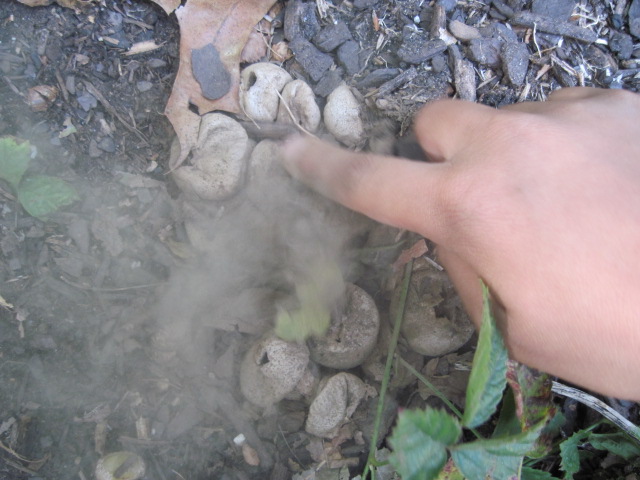
(c) 2012, Kim M. Bennett

(c) 2012, Kim M. Bennett
(c) 2010, Kim M. Bennett


Studying Puffballs

Puffballs make a great study for "One Small Square" activities, as there's a lot going on in a small area (check out the photos, above). Because they develop quickly, you can revisit the same spot quickly, over the course of a couple of weeks, and see things changing (good for working with little ones who need quicker change). Our crop of puffballs emerged and matured within a few weeks' time. Even after they matured, the shells of the puffballs remained for a long time, and were fascinating to my 8-yr-old, who always managed to get a few more spores out of them!

[Submitted to the Simple Science Strategies September Blog Carnival, and the Outdoor Hour Challenge September Blog Carnival]

Stay Tuned...

My All-Season Indoors Kitchen Composter (fueled with bokashi) arrived! Stay tuned for a review of this product (from UncommonGoods) in a couple of weeks (I'm very excited -- anything to stretch the gardening theme into the fall and winter...).

The All-Seasons Indoor Composter, $48 from UncommonGoods

Nadene at Practical Pages shares a hollow log indoor garden, complete with little honey mushrooms, that one of her children created for a homeschool learning project -- see it at "Freedom Homeschool Brings."


Will you help me out? 


Will you help me out?  Please click on the link below to answer a short, 8-question survey about your experience on my blog. No ads! Just information for me. Thanks so much!

Take the October 2012 Reader Survey  now.

Sunday, September 16, 2012

The "One Small Square" Strategy: Mushrooms and Other "Fun Guys"

Mushrooms love the woodchips in my flower bed.
[Edited and re-blogged from "A Child's Garden," September 2011]

We originally completed this study last fall, but are re-posting this for the September Simple Science Strategies newsletter, because it made good use of the "One Small Square" Strategy, the focus strategy for Week 3 of the September Newsletter, and focused on mushrooms, the topic for Week 2!


We sure have had some wild weather here in New England at the end of the Summer of 2011. We have had so much rain that the crop of mushrooms sprouting up everywhere has been very interesting and incredible.

Fall, especially the Back to School time, is always a prime time to go mushroom exploring, with the warm days, cool nights and more frequent rain.  Also be on the look-out for mushroom cousins, the slime molds and actinomycetes, that you probably mistake for their more well-known family members. Here is a mushroom study that you can do for September.

Before You Go Outside:

    Tiny shelf fungi on a dead tree, Fenton-Ruby Park and Preserve.
  • Read up on mushrooms. The Handbook of Nature Study has a very thorough discussion of many of the types of fungi that you might see on an expedition, on pages 714-727. If you read a little further, you can learn about their indoor cousins, the bread molds (pp. 727-728).
  • The Handbook of Nature Study website has an Autumn Outdoor Hour Challenge on Mushrooms that has excellent links to videos, notebooking pages and other resources.
  • Gather materials you might need for a mushroom study: clipboards and pencils, hand lenses, a long plant tag or flag to mark your mushroom spot, plastic food service gloves.
  • Read Outdoor Hour Challenge #9: One Small Square for a description of how to carry out the observation activity. 
  • Prepare observation sheets for each child. 
  • Review routines: "How to Work With a Partner."
  • Teach safety rules about potentially poisonous plants.

Honey mushrooms in a shady flower bed.
Observing Mushrooms and Their Cousins:

A mushroom study lends itself well to a multiple-day observation, since the fruiting body of most fungi only remains for a few days, and changes considerably with time and the weather.

Step 1: Note the location of some fungi on a nature walk.

Some places to look include wood chipped areas of a school flower garden or playground, rotting logs, tree stumps, and places where a tree once stood. At this time of year, a whole crop can pop up literally overnight, so don't be discouraged if you don't see any on a particular day.

Be on the lookout for the little "buttons" of some mushrooms that look like tan bumps before they sprout up the next day.

Step 2: Use the One Small Square technique to sketch what you observe.


Step 3: Mark the location with a stick or "flag" so you can find it the next day.

Step 4: Return to sketch changes for the next few days, until the mushroom collapses.

Mushrooms change very quickly from day to day, which is exciting for kids. Note the weather each time you observe (that day's as well as the weather from previous days). These observation forms have a place to record the weather.

Each day you observe, ask the students some questions:
  • How did your mushroom change? Why do you think this happened?
  • What was the weather like the day before? How might that have affected the mushroom?
  • What type of weather do mushrooms prefer? If you don't know, how can you find out?
  • Where are the mushrooms growing? What is the ground like there? Are there any trees around? 
  • Do you see any insects around the mushroom? What are they doing?
  • Does your mushroom have a smell? (Make sure that children don't handle the mushrooms without wearing gloves, because some poisonous mushrooms resemble harmless ones.)
Classroom Follow-up: 

Study the Anatomy of a Mushroom --
  • Enchanted Learning has a diagram of a gilled mushroom that students can label, to learn the anatomy of one type of mushroom.
  • The Mushroom Lady has a pile of activities that will get your kids really studying mushrooms in-depth.
 Learn About Mushroom Relatives --
  • Here is a handy sheet of terms that you might want to study, so that you correctly distinguish between fungi, actinomycetes, slime molds and other fungus-like organisms.
Study Edible Mushrooms (and Eat Them!) --
  • Create a mushroom study station with stereoscopes and various edible mushrooms from your grocer's produce department: shiitake, oyster, portabella, white button, straw, crimini...
Fairy Rings, Faerie Houses and Other Literacy Connections --
  • Study the folklore surrounding fairy rings and faerie houses.
  • Build a faerie house (or two or 10...) along your school nature trail or in your backyard garden.
Faeries and other woodland creatures -- literacy connection!

Will you help me out? 


Will you help me out?  Please click on the link below to answer a short, 8-question survey about your experience on my blog. No ads! Just information for me. Thanks so much!

Take the October 2012 Reader Survey  now.


Friday, September 9, 2011

September Study 3: Ants,Termites and Ant Lions


Originally published 2011. Edited and republished for the Simple Science Strategies Blog Carnival, September 2012.


Fall is a time when lots of creatures begin to make preparations for the winter, while the weather is still warm and food is abundant. It's a good time to observe insects, especially social insects, like ants and bees, who get busy in the fall preparing their colonies for colder weather.

Every fall and spring, there is a line of black ants that passes through our kitchen, from some distinct point outside, to some distinct point somewhere on the other side of the house. They annoy us for a couple of days, then they disappear as quickly as they arrived. Similarly, about this time of year, we witness a parade of citronella ants moving from point A to point B in the yard, leaving their tell-tale orange-y odor behind them


Ants are an easy creature to study using the One Small Square strategy for observation.


Before You Go Outside

  • Read up on ants in the Handbook of Nature Study (pp. 369-378).
  • Gather materials you might need for your outdoor studies: hand lenses, string or something else to mark your square, clipboards, a few crackers (one per pair of students), the observation sheet of your choice (see below).
  • Read One Small Square: Practice Looking Closely at the World and Outdoor Hour Challenge #9: One Small Square for a description of how to carry out the observation activity. 
  • Prepare observation sheets for each student.
  • Teach students how to work with a partner.
  • Review the five senses.
  • Find a place that is out of the way where you can set up your observation area. I used to use the sandy area at the edge of the blacktop on the playground as my ant observation area. The area should be large enough to accommodate enough "squares" for all the pairs of students in your class. If it makes it easier for the custodians, mark out the area with stakes and "flags" so it doesn't get disturbed.

The One Small Square Strategy
  • Pair up your students. Think about roles -- do you want all students to sketch and record, or do you want one student to take the job as recorder?
  • Take the students outside and let them choose a "square" as their study area. (If it makes it easier, pre-mark the squares). Guide students to select an area where there are signs of ant activity. 
_________________________________

Five-day study:


Day 1:

  1. Use a journal page with a large space for illustration. Draw the ant hill in your square. 
  2. Where are the ants? Which direction are they heading? Watch what they do when they meet one another. Do they appear to interact with one another? How? What are the ants doing as they move about?
  3. How many ants do you think live in the ant hill?
  4. What do you think their home looks like below ground?
  5. Write some observations in your nature journal.
Day 2:
  1. Use a lined journal page with a small space for illustration today. Find one ant. Draw it in the small square. 
  2. Watch what your ant does. Try to make a note every minute or two minutes (you'll have to practice writing notes, not full sentences). 
  3. During this time, your partner should watch a different ant, recording what that ant does.
  4. Do the ants appear to have jobs? Do all the ants do the same activities? Compare your observations to your partner's. Did your ants do the same things?
 Day 3:
  1. Use a journal page with a half-page for illustration, and half-page with lines. Take a cracker with you when you observe your ant hill.
  2. Place some cracker crumbs where the ants are active, but a few inches away from the entrance to the ant hill.
  3. How long does it take for the ants to find the cracker crumbs? What does the first ant do? What happens next? Do other ants come? How do they know to go there? Where do they take the cracker crumbs?
  4. What do you think they use the cracker crumbs for? Why do you think this?
 Day 4:
  1. Use a journal page with space for two illustrations. Label one "before" and one "after."
  2. Draw your ant hill as it looks today. Make sure to note where ants are located, also.
  3. Now, carefully cover the entrance to the hole in the ant hill, by brushing the sand into the hole.
  4. Watch how the ants respond to this. What do they do? Do they become more active? Do they run away? Do they unblock the hole? Talk to your partner about what you see.
  5. About 5 minutes before your observation is finished, draw the way the ant hill looks. Did the ants unblock the entrance? Did they create a new one? Did they work together? How did they cooperate? Why do you think ants behave this way?
Day 5:
  1. Use a journal page like the one you used the first day. Go outside to observe your ant hill when the weather is very different from the first day (for example, after a rainstorm, or on a cold day, or a very hot day).
  2. Draw what you see. Does the ant hill look different? Why or why not? Are the ants doing the same things as the other days? If they aren't, why not?
  3. Can you make an inference about the relationship between activities of ants and weather? 
________________________________________________

Follow-up Activities in the Classroom:

Termites
Learn More About Social Insects
  • Use the library and the Internet to learn more about social insects, such as honeybees, ants and termites.
  • Global Newt has online games that teach about social insects, using a termite mound, bee hive and ant hill as the settings for the game.
  • Record your research on this research worksheet

 ________________________________________________


Ant lion pit
Look for Ant Lions
Ant lion (doodlebug). (c) Scott Robinson, 2005 via Creative Commons.


________________________________________________

Identify Your Ants


Citronella ants smell like citronella candles when disturbed. (c) A Child's Garden, 2010.


_________________________________________________  
 Literacy and Math Connections


Will you help me out? 

Please click on the link below to answer a short, 8-question survey about your experience on my blog. No ads! Just information for me. Thanks so much!