Showing posts with label gardening. Show all posts

Wednesday, July 2, 2014

New Garden Additions! June Updates...

When you live in a family of horticulturists, plants just... happen. I spent the last week acquiring new additions to my front garden. Here they are!

My New Garden, in June...

I'm participating in the "3 in 30 Challenge", and one of my goals for June was to install a new flower bed in my front yard. My dream was a kitchen garden, where I had a smattering of veggies, herbs and flowers to bring in to the dining area for cut flowers.

Hydrangea - we're still trying to figure out
which one this is...


This hydrangea was one of a batch that was not in flower, and had not been labeled, so it was impossible to identify (or sell) at the nursery. We're still trying to figure out what variety it is -- we had thought it would turn out to be 'Endless Summer,' but the colors are wrong. You should see how it looks today! Each flower head could actually be cut and floated singly in a low dish as a centerpiece -- they are just enormous.

I have several hybrid tea roses, which I share below. The yellow is not yet identified. The red, 'Don Juan,' fairly glows at dusk -- my husband was admiring it from the front porch one night, and said it just screams out, "Alive!" Very poetic guy... The third rose is called 'Love,' and I'll have a photo of it next time -- white buds, edged in red, opening to red on the inside.

Hybrid Tea Rose -- no label so your guess is as good
as ours!

My son brought more roses home yesterday -- I don't know their names yet, but here is what will come home to Mama (!) today:

  • another yellow, with the most amazing scent...
  • a red that's nearly lavender...
  • one called 'Joseph's Coat' that my son knew I'd like, just because of the name, but it is beautiful, with yellow buds tinged in orange, and red edges to the petals...
  • a coral-colored one...
He had an orange-orange one, but, before I could point and say, "Ooh! I want THAT one!" he said, "And you can't have the orange one, because I want it!" Darn it. Those cut-throat gardeners...


Hybrid Tea Rose - 'Don Juan'

Some people avoid hybrid teas as "too finicky," but I find roses to be no trouble, at all. Sometimes you have to watch for mildew, especially on the fuller ones and especially if your weather has been sultry like ours has. But I don't consider cutting back spent flowers and removing spotty leaves to be a big chore -- it's kind of therapeutic at the end of a work day. Maybe that's what people are considering "high-maintenance?" Don't know. I call it "puttering," and it makes me happy.


New roses, cleaned up and ready for planting

I love to rescue plants and resuscitate them. I have been known to frequent places like Lowe's and Home Depot, looking for the carts where they stack the unsaleable plants. If you know plants, and "big box" stores, you know that something becomes unsaleable when it is out of bloom. I don't care if I have to wait until the next year, when I can buy up a bunch of the same things for a mass planting, and only pay $0.25 (or nothing!) apiece. I acquired an entire planting of ornamental Solidago at Lowe's one year, simply because the flower heads had gone to seed, and the employees thought they were all weeds!

My new roses cleaned up nicely. The next batch are some interesting (mis)shapes, so I'm thinking I'll cut them back hard after they finish flowering.

Siberian wallflower - a wonderful wildflower
that is easy to start from seed


My neighbor had a pot on her front step. It contained the remnants of a plant long since expired, in petrifid peat moss. She is a very nice lady, a retired nurse, and I told her one day that I was going to plant something nice in her pot and leave it on her step.


I had this package of Siberian wallflower that came (I think) as a freebie in some gardening junk mail. I never throw any of those seeds away. Usually, I save them all up (wallflower, cosmos, viola, herbs, all those other things they send you), buy a nice wildflower mix, mix them all together and then broadcast it somewhere that needs color but not gardening. Most wildflower seed shouldn't be covered, as they need sunlight to germinate. Wallflower comes up right away, but it's a nice surprise to come back a couple of years later and find a lupine or other biennial flowering.
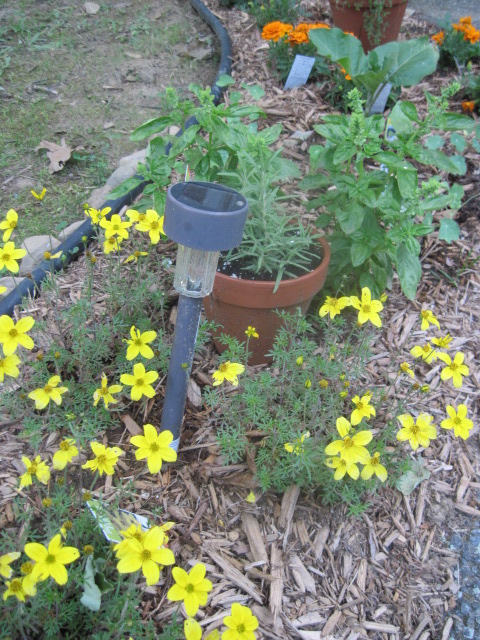
Bidens, or Beggarticks

I have many different types of Coreopsis. This is not actually one of them, although it looks like one. This close ally is one that I bought at Wal-Mart, called Bidens, or Beggarticks. Like Coreopsis, it is very durable, and hasn't once withered or shown signs of stress during our incredible heat wave. My rosemary also has enjoyed the more Mediterranean clime we've had lately.

My middle son teased me about the containers that have placed in spots around the garden. Until the plants grew up, I wanted some more vertical elements. Plus, terracotta is cute. He later admitted that he really liked it and was just giving me a hard time.

Then he went out and installed a slammin' garden of his own. I like to think that his mother inspired him! Plus all those beautiful plants he and his brother work with all day -- it would be hard for me to bring home any money. My family would have to learn to live on beauty, alone.


Eggplant 'Black Beauty'

I love interplanting veggies, herbs and ornamentals. I rarely have insect problems, because I use companion species, such as Nasturtium (which is so tasty it lures the bugs to it instead of the veggies AND you can put the peppery flowers and leaves in your salad), the ubiquitous marigold (I'm partial to the dwarf, dark single-blooming kinds) and others. I notice that the squirrels wait until my eggplants are about the size of eggs, then, just as I'm beginning to fantasize about a good "parm," they steal them. So I planted my eggplants in the front bed, where the squirrels won't venture. We'll see.

Planting solar patio lights in pots
I planted some different herbs this year. I have the regular English thyme, and an ordinary (but wonderful) basil, but I also have licorice basil and a wild oregano, some wild monarda, and I'm not sure what else (because I sprinkle the seeds in places everywhere). Nice butterfly magnets, and the sun on the basil by the front walkway smells heavenly.

I am trying something different with my patio lights this year. Why shouldn't I get to enjoy my garden when I sit out in the evening, too? I "planted" my patio lights to highlight spots in the garden, and I love it! Here's something I discovered: if you put a patio light in a hanging basket, it acts like a porch light, without electricity! My little guy also told me the mom of one of his friends started putting her patio lights in her hanging baskets, too.

There is a little toad that hides under the pot at night. Did you know that one toad can eat 10,000 pests in three months? Love your toad -- plant a toad house.


The marigolds have not cared at all about heat, drought,
or any other adverse conditions!

Speaking of toads... Garden Toad's Companion Plant Guide lists a bunch of plants that can be planted as companions to your veggie plants, and the way that they are beneficial. Lots of my things are on there, but next year I'd love to do more purposeful planting -- I'm already excited...


My Current "Companions"

basil... catnip... cucumber... marigold... mint... nasturtium... oregano... parsley... rosemary... sweet pepper...

I am making a list for next year, though!


My nasturtiums are tumbling everywhere! I like the old-fashioned, rambly ones because they weave their way among the vegetables and flowers, providing spots of unifying color all over. This planting is in a pot that contained pansies (still doing well, in spite of the heat). My thinking is that the pansies would fade in time for the blooming of the nasturtiums, but it looks like they might co-habit, after all!

I found some nasturtiums growing in a place I don't remember planting them. It's hard to believe that I spilled those humongous seed and didn't notice. Do you sometimes plant things and forget that you planted there?

There are worse surprises!


Hypericum (St John's-wort)

I have a little creamer pitcher that I keep on my dining room table, that is the perpetual flower arrangement. The other day, I noticed these Hypericum (common St. John's-wort) flowering by the edge of the driveway, and cut a few to add to the arrangement.

If you want a field guide that is friendly to kids and people who aren't familiar with plant classification, then the Peterson guides are great. Plants are organized by color, then you use botanical features to narrow the selection. This is the wildflower guide that I used.


See my Weekly Photo Challenge blog entry for
more about this photograph

Before the St. John's-wort came to live on the table, I had trimmed some new perennials after they were transplanted, and used the trimmings to create an impromptu arrangement. Here are some of the Coreopsis that made their way to the dining area.

You can read more about this photo in Weekly Photo Challenge: Create.  If you enjoy taking photographs, and have a WordPress blog, consider participating in this photo challenge.

Another photo challenge I participate in is the OHC Summer Photo Challenge, sponsored by the Outdoor Hour Challenge.  Details about this challenge, and how to join up, can be found on the blog link, above, or at Barb's Pinterest board, Summer Photo Challenge, OHC.

Next to blogging, I love taking photographs of stuff to blog about best!

Stay tuned for updates on my garden. Until next time, happy gardening!


Even the tiniest flower bed or vegetable garden can be a rich source of nature studies for all ages. Even if you only have a sidewalk planter or a patch of vacant lot, you can learn great things about the plants that God gave us for food, beauty and shelter.

Check out the notebooking pages from my friend and fellow homeschooler, Debra Reed -- you won't be disappointed! 

Tuesday, June 10, 2014

Winged Garden Visitors

"My beloved has gone down to his garden, to the beds of spices, to pasture his flock in the gardens, and to gather lilies." (Song of Solomon 6:2)

---------------------------------------------------------------


Over a single day last week, there was an influx of all kinds of interesting moths to the garden. I took pictures of a few of them that sat still long enough. Here are my visitors:


Harnessed Moth [(c) 2012 Kim Bennett]

Rosy Maple Moth [(c) 2012 Kim Bennett]


Common Gray [(c) 2012 Kim Bennett]
Great pages for insect study!

Stay tuned for nature studies on moths and butterflies in future posts on "A Child's Garden."


Happy moth gardening!


Saturday, May 24, 2014

My Rock Garden Wish List


"He is the Rock, His work is perfect: for all His ways are judgment: a God of truth and without iniquity, just and right is He." -- Deuteronomy 32:4

I just finished putting together my shopping list for the rock garden I want to install in the back yard. I am going to try some trench gardens in the cracks and crevices that are in the ancient stone wall that runs across my back yard. Here's my list, so far:


The old stone wall behind my house


  • Sedum - creeping varieties
  • Thymus - I have a lemon thyme -- looking for something different
  • Lewisia - a new one for me
  • Saxifraga - also new for me
  • Eriogonum umbellatum - another newbie
  • Salvia pachyphylla - a different Salvia from the ones I have
  • Campanula - I saw a picture of a compact one in BH&G, but only have a tall one in my yard, to date -- would love a midget size one
  • Heuchera - I collect these...
  • Alyssum - an old stand-by for rock gardens
  • Dianthus - the grass pinks...
  • Scabiosa
  • Euphorbia - compact ones...
  • Lobelia cardinalis - I never saw a compact form until I saw BH&G's rock garden slide show; I have a shady, damp spot that would be perfect


I'm off to the garden center to look for landscape edging, potting soil and wood chips to construct a flower bed in my front yard. I'll keep you posted on the progress as part of my 3 in 30 Challenge. Click on the button to start your own challenge! And see my blog posts at A Child's Garden for updates on how I'm doing on all my gardening goals!

Peace to all!


Monday, May 19, 2014

Birdies, Butterflies and Blooms

"Every word of God is pure: He is a shield for them that put their trust in Him." (Proverbs 30:5)


Love that fuschia!


I was sent to Home Depot the other day to buy new blades for the weed whacker. I told my husband that this hanging fuchsia somehow got into my cart and I must have accidentally paid for it, because, LOOK! here it is in my trunk!


My husband just smiled. He lets me play with plants, because it's a lot cheaper than most vices folks might have, it makes us happy, doesn't get anyone into trouble, and makes us feel like we are continuing where Adam and Eve should have left off.


We like to sit on our front porch in the evening. There is a common "green" with a little gazebo in it, in the center of our neighborhood. All the children (and their parents!) congregate there for frisbee golf, cookouts, guitar and drum practice, and general fun. So we hung our hanging baskets on the front porch.

Within a day, the hummingbirds found the basket! My husband enjoys them immensely, commenting on how loud their wings are when they whiz past your head, and how unafraid they are.  It makes me very happy to see them.


I have written in the past about other flowers that attract wildlife. See Humming (Sphinx) Moths for a list of other plants you can include in your garden, to attract birds, butterflies and other wonders.


Monday, December 16, 2013

More Homeschool Poetry Resources

Snow, snow and more snow! (c) Kim M. Bennett, 2013

A Winter Wonderland

Since we last chatted, we've had about a foot of snow, temperatures down to the teens and up to almost 40 degrees, one vehicle stuck precisely two times, one backyard clean-up day, one early dismissal (and a possible closure tomorrow), and a dead battery on a thermostat. But the snowblower started on the very first pull!

This has been a great week to get in a lot of work preparing workbooks for our youngest son to use next year.


Next Up... Carl Sandburg

Ambleside Year 6 includes a study of Carl Sandburg -- one of my favorite poets. As with the Robert Frost pieces (see, "... On a Snowy Evening"), I compiled a number of recommended poems of Carl Sandburg into e-book format.


Click the link to download a FREE copy of this 32-page e-book.


You can print the pages double sided or single-sided, with lined copywork paper on the reverse -- it's up to how you will use them. I will print them double-sided, and include pages from Harmony Art Mom's poetry analysis materials (see, "Poetry for High-Schoolers" for links to the pages, which include excellent response to poetry prompts). If you want some great copywork pages to use with these poems, see the variety of blank copywork pages at the Notebooking Treasury, including these Celtic design pages, with lines for a variety of length of stanzas for copying or dictation work.


More Poetry Planning

We will be studying Alfred Noyes for Term 3 next year. I was familiar with his poem, "The Highwayman," but not much else. Look for the next e-book with a selection of poetry by this English author.

We are also having a GREAT time planning our organic gardens for the coming spring. We hope to make really great use of our mini-greenhouse, and to can a bunch of food for next winter. Stay tuned for more gardening details!


Get 10% off gorilla grow tent when you shop at www.AccessHydro.com. Valid until January 31, 2014.

Thursday, October 18, 2012

Adventures in Composting: The All-Season Indoor Composter


I am so excited! I just emptied my first batch of pre-compost from the All Season Indoor Composter, by UncommonGoods...

I first learned about UncommonGoods during a Mother's Day Pinterest board competition last spring. Because some of the pins were to come from their products, I had the chance to browse their online catalog. They were certainly uncommon, and right up my alley!

UncommonGoods


So when I was offered the opportunity to try out a product in return for writing an honest review of it, I had already started a wishlist. I found so many interesting, fantastic gift ideas here!

I was fascinated with the composter, for several reasons:

  1. I've been a "composter" for decades -- just feel good returning things to the earth...
  2. I currently use a small roaster with a lid to store compost prior to heading to the compost pile, and tend to pile it then set the lid on top of the pile, instead of emptying it promptly. Yuck.
  3. I need something that will fit under the sink, since my counter is too crowded for a countertop storage container.
  4. I was in the middle of a homeschool unit on mushrooms, fungi and other "composters" and the kitchen composter fit right into our studies.
A wonderful man named Rocky sent the composter to me, with a refill of the bokashi that fuels it. And the rest was history!

Here's our composting story...


The All-Seasons Indoor Composter, $48 at UncommonGoods.


The Composter


The composter isn't really a "composter." Composting is an aerobic process: bacteria, fungi and actinomycetes that love air break down the vegetable products into an organic material that you can use to amend your garden. In the All Season Indoor Composter, the process actually is fermentation, not composting, and is anaerobic: it depends on you depriving the microbes of oxygen. (See this YouTube video for the difference -- not sure about his claims that compost piles create environmental toxins, but he explains the difference between the two process well. The Compost Guy provides a little more balanced presentation of traditional composting vs. bokashi composting).

So why is this important?


How you use the composter, and how it's constructed, actually keep air out. (Those of you who compost, and are used to turning the pile to aerate it, will understand the difference).

The composter, itself, is a neat bin (about 5 gallons in size), with a tight-fitting lid, a handle and a grate that keeps the composting products from the liquid which collects with the fermentation process. The composter comes with a bag of bokashi, a mixture of wheat bran and molasses which is "inoculated" with fermentation bacteria, which break down your compost in the bucket. Rocky sent along a second bag of bokashi, but I didn't need it. The composter fit perfectly under my kitchen sink.

The All-Season Indoor Composter fits neatly under your sink.

Bokashi - the Fuel for the Composter

A little about bokashi (from my research)...

Bokashi is a mixture of wheat bran, molasses and a special blend of microbes called "effective microorganisms," or EM, for short.  If you read reviews of composters such as this one, some folks talk about the odor of the bokashi. Do you want to know what it smells like?

Cattle feed.

If you're not a farm girl or guy, it's hard to explain. It's sweet smelling, a little like taking a big sniff in a box of guinea pig pellets, but stronger. That's all. Not nasty. Very alfalfa-y.

Bokashi, the fuel that powers the All-Season Indoor Composter.


In fact, I'm thinking that, with the exception of the microbes, the mix is probably a lot like most animal feeds. My dog was very intrigued with the smell of the bokashi blend as I prepared the bucket.

You can make the mix yourself, or (conveniently) purchase bokashi refills from UncommonGoods, for $12.00.

Filling the Composter

It is extremely easy to use the composter:


Put a layer of bokashi on the bottom of the composter.
  • Remove all packaging from the composter.
  • Add a generous handful of bokashi to the bottom of the composter, taking care not to block all the holes in the bottom grate. 
The grate at the bottom of the composter lets the liquid that accumulates during the fermentation process drain out of the compost, and into a separate part of the composter. From what I'm able to read, this was an improvement based on consumer suggestions.


    Any kind of vegetable and meat waste can be added.
  • Add your organic waste to the composter.
The directions say that you can add the following items: any vegetable scraps, and small amounts of meat scraps. You are not supposed to add materials that have already begun to spoil.

What I added: stale cereal, vegetable scraps, used napkins and paper towels, coffee grounds and filters, small amounts of paper, egg shells.


Stir the mixture after each addition of waste.
  •  Dust surface of waste with more bokashi, then stir with a spoon to coat all.
The directions say to cut everything into small pieces. I didn't -- I wanted to compare what it did with materials that I would put into my compost pile as is. I know if I have to chop my garbage, I won't use the composter.

I was not brave enough to add meat scraps to the composter this time.


Add an additional layer of bokashi before sealing the bin.
  • Each time you add waste, coat the layer with a generous amount of bokashi. 
  • Stir after each waste addition.
  • Push down the compost to push out extra air.
  • Add another dusting of bokashi before sealing.
Don't be skimpy with the bokashi -- it contains the microbes that keep this process going without rot organisms, that cause bad smells.


Seal the mixture with a plastic bag or a plastic plate.


  • For added air-tightness, cover the compost with a plastic bag or plate, to keep air out.
I tried a nicer looking styrofoam plate, but didn't find that 1) it covered the whole surface of the compost or 2) sealed the mixture as well.

Oh, well...


  • Put the composter under the sink.
I have to say that I never noticed ANY smell from the composter. It seals extremely well. And I didn't use it exactly as the directions said (but DID use it the way I know I would use it):

  1. I tossed the materials into the bin, then added bokashi and stirred it at the end of the day, but not with each addition.
  2. I probably didn't always get the lid on tightly.

The Finished Product

After about 10 days, the composter was full (that seems typical for a family of three). The directions said to let the material process an additional 5 days before removing from the bin, so I did. Here is what we had after that:


The "tea" -- liquid that accumulates with fermentation.

The directions say that you can drain off the liquid periodically using the handy spigot at the bottom of the composter. I suppose this is more of an issue if you use a lot of juicy products (but they say to not add too much liquid to the composter, so...).

Anyway, this is all that accumulated in our bin (about 1/2 cup). I filled the rest of the little container with water, and used the mixture to water my rosemary plant.


The compost, after 15 days of processing.

After the 15 days, the mixture is not yet done. The directions tell you that you have to now bury the mixture in the ground to finish the process. I haven't done this yet (we just emptied it this evening), and wonder what I will do in the winter (you don't dig anything in the ground here in New England, in the winter).

I was impressed with the amount that the melon rinds, eggs shells and cucumber peels broke down. Good stuff.


Another view of the finished product. Nice, huh?

What I'd do next time:

  1. Dig the hole for the finishing of the compost ahead of time, so I could just dump it in the hole when I'm finished.
  2. Try to compost everything organic: paper from the office shredder, paper towels and facial tissues, shredded newspaper (why? because I normally compost all these things -- if I can't compost all the things I normally compost, I'll be disappointed).
  3. Try adding meat scraps to the compost.


The empty bin.

The directions tell you not to add anything that already has begun to spoil. That was a little disappointing. There's something a little ironic about throwing the rotten cucumber that hid in the back of the crisper, in the garbage, instead of in the composter. I think I might try it in the composter next time. I'll let you know what happens.

The smell at the bottom of the bin wasn't as pleasant as the top. But it wasn't as bad with the bokashi as most rotten stuff smells. 


My Recommendations

The All-Season Indoor Composter provides a spacious, odor-free way to store your compost inside until you can get it into the compost pile or pit. The bokashi makes the food waste break down much more quickly than it would in an empty container on your counter, and the pre-compost product breaks down to about 1/2 its starting volume during the finishing process in the bin. Although you have to then bury the product outside before using it as compost (it's not finished yet), the bin at least provides a convenient way to collect these scraps without mess, smell or pest problems in the house.

If you like feeling good about returning organic materials to the environment, then the All-Season Indoor Composter,  from UncommonGoods, is a perfect addition to your "green" living routines.

Mine is being refilled for another "go-around," even as we "speak."


Other Things on My Wishlist at UncommonGoods

There are so many great unique finds for girls at Uncommongoods -- I am particularly fond of the Periodic Table Building Blocks, being a science girl and somewhat of a geek.


But, their picks for guys are just as intriguing: a President Block Set (my history-loving youngest son would go bonkers over that), and the older two (who are former Rubix cubers and chess masters) would appreciate the Lab Test Games.


For myself, I love the one-of-a-kind garden accessories, in particular the Apple Anchor Hummingbird Feeder and the Butterfly Puddler. I know these would be perfect in my garden -- we get a zillion hummingbirds (they come to anything red or shiny), and the orioles and bluebirds eat fruit left out for them in the yard. I also have noticed many butterflies drinking out of the "puddles" in plant saucers, so the puddler would be a pretty addition -- like a stepping stone with a dual purpose.


I'll have to wait until spring for those things... sigh. I so miss summer already.


Will you help me out? 

Please click on the link below to answer a short, 8-question survey about your experience on my blog. No ads! Just information for me. Thanks so much!

Take the October 2012 Reader Survey  now.