Showing posts with label literacy. Show all posts

Sunday, July 29, 2012

NEW! Botany Notebooking Pages for Fall...

[Re-blogged from Books and Blooms]

Right now, in New England, we've pretty much finished picking strawberries, and are now heading into blueberry season. It will be a minute before we will be out collecting bags of apples.

But I noticed at Wal-Mart the other day, that there are shelves and shelves of notebooks and lunchboxes on display, and I just got my son's school supply list from his fourth grade teacher, so can September be too far off?

For those of you preparing curriculum for the fall, come see my new science journaling pages.

"An Apple a Day" is the first in a series of science journaling pages that follows the  apple tree throughout the year. This first set focuses on the formation of the apple fruit from the flower.

The next set will focus on the fall colors of fruits and leaves.

For more information, see the Store at Simple Science Strategies.
See Simple Science Strategies for details!

Sunday, May 13, 2012

You, Too, Can Teach Literacy!

Two brothers and a game of Chinese checkers.

I was talking to a good friend the other day. She has a delightful little daughter, who is a kindergartner. The little girl, like my youngest son, was probably what Mary Sheedy Kurchinka had in mind when she wrote her book, Raising Your Spirited Child. The two of us were chatting about how school was going, and I said that (after a brief few months back in public school) my son was looking forward to homeschooling again in the fall.

My friend thought for a moment, then said, "Well, if I were smarter, I'd probably homeschool my daughter." I felt sad. We are all smart enough to teach our own children!

Lots of parents who are considering homeschool (and even teachers who teach in public schools!) ask me how we do it -- how do we decide what to teach, how do we make sure that we "cover" everything, etc., etc. I don't have answers to all of those questions, but I can tell you that my son can read and spell everything, knows stuff in science that most adults don't know, and just loves the story of Richard the Fearless of Normandy. I think he's an ok kind of kid!

But I know that it was helpful to me (and still is!) to hear other homeschoolers talk about homeschool. So I thought about the first thing that most parents think of when thinking about homeschool curriculum:  teaching literacy.


Literacy includes many different parts: reading and writing, spelling, vocabulary, listening and speaking, grammar and language. Teachers use state standards to teach all of these parts. But, in homeschool, this can seem overwhelming -- so there is an easy way to make sure that we cover all these things, and we can do it in a way that, well, seems like home.

The Daily Five is a skinny little, wonderful book written by teachers with school teachers in mind, but they describe literacy in a very parent and child-friendly way. In their book, the authors, Gail Boushey and Joan Moser (lovingly referred to as "the Two Sisters") break literacy up into five different activities:

  • Reading to Self
  • Reading to Someone
  • Listening to Reading
  • Working with Words
  • Working on Writing
Doesn't this all sound like what you do in homeschool, already? I thought so...


Here I'll address each one, and give you ideas for how you can make sure you are providing a rich experience for your child at home, without turning your home into school, or spending a lot of money.


Reading to Self

Research shows that the more kids read, the better they read. And, the more they read, the more words they know. And the more words they know, the smarter they become. So reading is a good thing!


When I was a classroom teacher, parents would ask me what they should get for their kids to read. I said, "Anything they want to read!" There is merit in anything: encyclopedias, wordless picture books, the back of the cereal box, the telephone book, the same dog-eared copy of Captain Underpants that you've read 72 times already... Whatever your child wants to read is a good read.

I "require" 30 minutes of reading as independent work, each day, but that is rarely a problem. I also have "bribed" my kids (all of them) into going to bed on time by allowing them to stay up a half-hour past their bedtime if they are in their beds reading (this has worked in our home for 24 years, and most of my students' parents report it to be a success, too!).


The simplest way to keep track of your child's independent reading is through a reading log. There are so many forms of this. DonnaYoung.org has a number of homeschool book lists that you can print out and keep in your plan book, or you can create your own and print it out. Teach your little one how to write the title and author, and how many pages/minutes he read. Sometimes I would add something else to the log, depending on what we were working on: genre, a simple rating scale, who would enjoy this book (audience), etc. [We also keep an inexpensive spiral notebook as a response journal, where I would write questions (mostly "think about" kind of questions, like, "Why do you think Opal's dad doesn't want to talk about her mom? What are your clues?"). I made sure that I wrote back. More on this in the "Work on Writing" section.]. Use Scholastic's "Book Wizard" to find great books.

My kids could spend the whole day in the library. Nowadays, there are so many activities in the local library: computers, story hours, visiting speakers, arts and crafts times, and reading contests. Many libraries in the city (like where we live) serve lunch during the week in the summer, and snacks after school. If you don't have air conditioning, it's not a bad place to hang out on a hot day. If you tell your librarian you homeschool, she will often be on the lookout for books that you want to use in your studies, too.


Now that my son is older, some of his assignments have independent reading parts. When kids are very little, they might just "look at" books, but this is reading, too. The idea is for them to independently engage in reading things they like to read, to develop of love of reading. If you want to check the reading level of the books your child is choosing to read on his own, check out Scholastic's Book Wizard tool, which is easy to use (see the "Teaching Tip," above, and the screen shot image, for an example of what you get from the tool).


Reading to Someone

Reading to someone helps children develop oral reading fluency. What this means is that they read smoothly, at a natural pace, with proper expression, and that they read accurately. Children that can read fluently out loud tend to be the children that also understand what they are reading, better.

When children struggle over words, they read texts too slowly to connect the words together, which is what makes meaning. This also tells us that they are having such a difficult time identifying words that they are missing what the story is all about. On the other hand, kids who read too fast also miss the story line.

There are lots of easy ways to make time for your child to read out loud.
  • Switch roles. I read to you, or you read to me (take turns - give the child a choice).
  • "Read to Me" Fridays. Let the child choose the book she wants to read.
  • Read plays together. Take roles and read the play like a "Reader's Theater."
  • Share the dialog. Let one person be the narrator, and the other read the dialog, in novels.
My kids used to love the Magic Schoolbus books, and they would never let me skip all the little speech and thought bubbles on each page. Not easy to read! But how much easier (and more fun it became) when we would each choose a character, and turn the book into a Reader's Theater, each reading that character's thoughts and dialog.


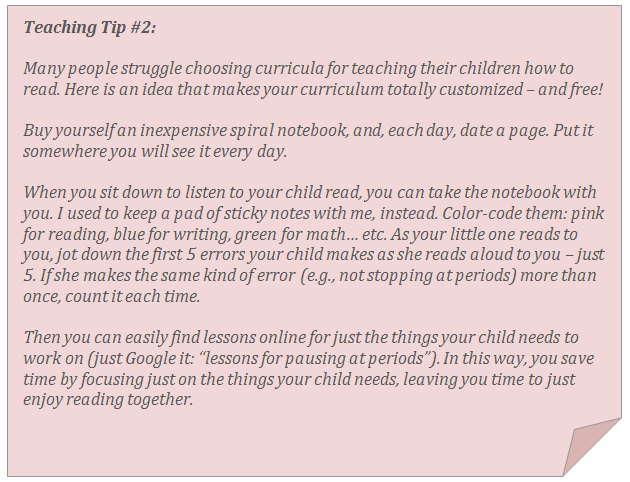
I don't use a reading curriculum. I listen to my son read, and keep track of what his errors are, then find lessons online to address those specific things (see "Teaching Tip #2").  For example, if I search online for lessons on pausing at periods, I find many ideas for helping students to pay attention to punctuation, from color-coding different types of punctuation, to practicing reading sight-word phrases instead of individual words, to reading fun books like Eats, Shoots and Leaves: Why, Commas DO Make a Difference!


Listening to Reading


This is probably the biggest advantages that homeschoolers have over public schoolers when it comes to reading instruction: the fact that so much of our "instruction" during the day is read-aloud. Children learn how to be fluent, problem-solving, understanding readers when a fluent, problem-solving, understanding reader models for them! (Pssst.... that's YOU!).


The purpose of listening to reading is to learn what good readers sound like, what they do when they read, and how they think. Read-aloud is the best way for you to do this with your children. You don't have to even be a stellar reader to be a great reading teacher. I have a teacher-friend who excels at reading instruction, because she, herself, was a struggling reader until about grade 4. She knows where children get stuck, because she did, herself.


To choose great read-alouds, check out the Bookfinder at Simply Charlotte Mason, where you can search by grade-level, curriculum year or topic.


Here are other easy ways that you can vary this part of literacy:
  1. Books on tape/CD. One of my children wore out his audiotape of Chicka Chicka Boom Boom as he read along. Nothing like Ray Charles teaching you how to read!
  2. Story time at the library. Many public libraries have story hour during the week, for preschoolers. Your younger elementary homeschooler might enjoy these opportunities. Often, towns will bring in guest readers or visiting authors to read, or even perform with puppets or drama -- a nice change-up from reading at home.
  3. Stories on TV. There is a place for the judicious use of "screen time" in homeschool. My eldest used to enjoy Reading Rainbow, which boasted an assortment of guest celebrity readers, as well as book reviews by other kids. You can find free episodes to watch online, too (see the link, for one site).
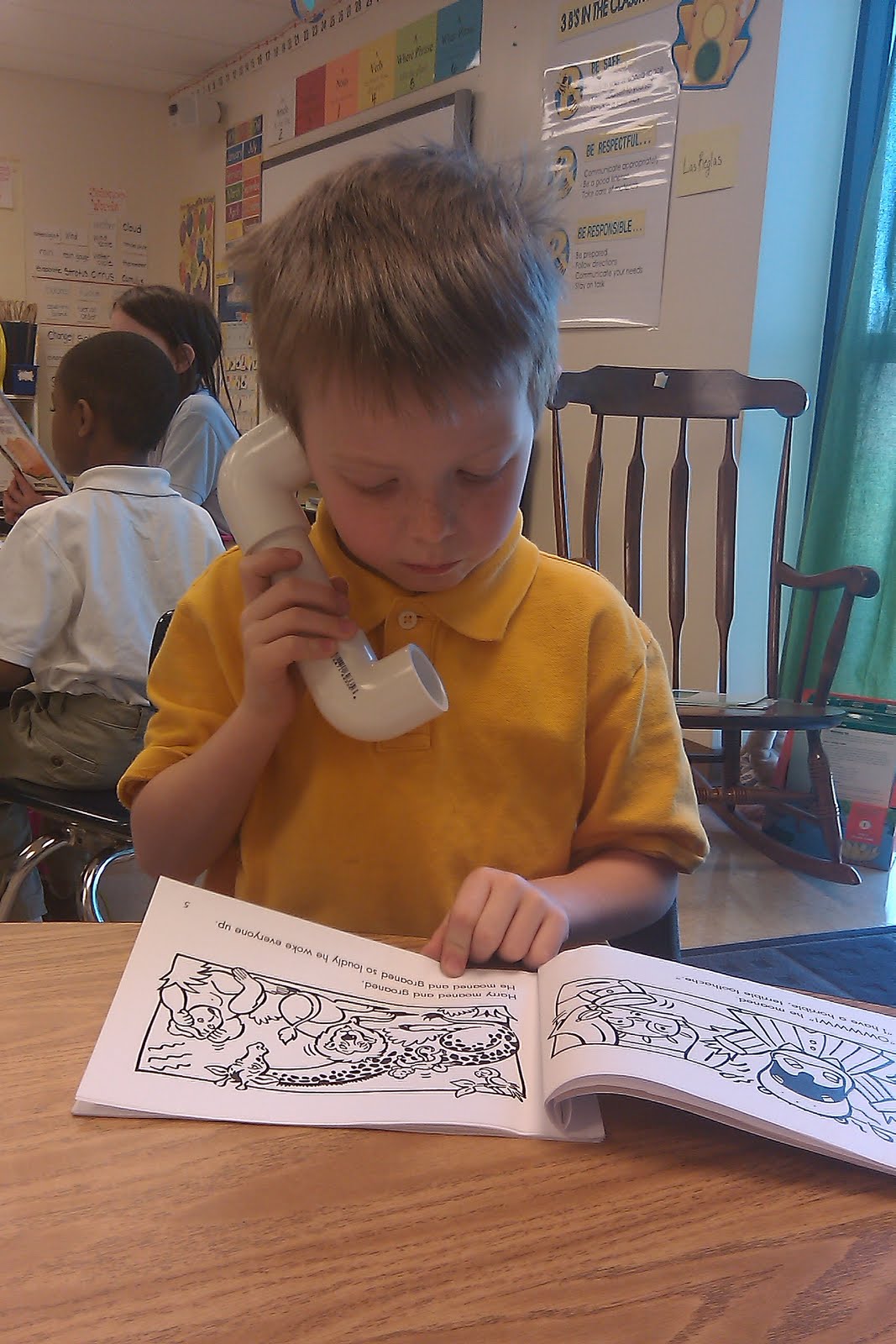
  4. Whisper Phones. Some of my teacher friends have been using these tubular contraptions, and one even had her husband make them out of PVC pipe and elbows. I am including a photo of a first grade student using one (click on the link to go to the teacher's website), and a link to plans for making your own, in case you'd like to try that idea out. The idea behind it is that the student who is working on reading more fluently hears himself reading in a whisper, and pays attention to his own reading better than by reading aloud. Kids love them, and they do seem to work.


Working with Words

We love word play in our house. My husband can switch syllables and starting letters around in words so quickly that sometimes we have to pause and figure out what he just said. Jokes abound, and we try to outdo one another with what we call "refrigerator words" -- the kind that you write down on a paper and hang on the refrigerator to remember later.


Working with words in homeschool is easy as can be. Here are some ideas that are fun for families, and reinforce how words work and are put together:
  • Word games. Our family favorites include Scrabble, Boggle, and Upwords.
  • Crossword Puzzles. Our science workbook (Flying Creatures of the Fifth Day) includes a crossword puzze as a review of each lesson.
  • Books about working with words. Some ideas: Frindle, The Word Eater, Donavan's Word Jar.
  • Books that also have fun with words. Anything by Dr. Seuss, Alice in Wonderland, and Shel Silverstein poems.
My sister-in-law taught my nieces how to read at a very young (pre-K) age, by labeling objects around the house. Everywhere the girls went, the objects were labeled: "table", "refrigerator", "chair", "stove"... If you are wanting to work on sight words, this is a more natural way to teach them than sheer memorization. Sight-word bingo is another fun way to learn sight words. You can find many sites for printing out bingo boards.

If you want to work on particular phonics lessons, make them game-like. Write the chunk you are studying ("pl-" for example) on an index card, then use Scrabble tiles to build the rest of the word. Sort the words you make into sense and nonsense words.


When my eldest was a toddler, I used one of those photo albums with the clingy pages, and labeled each page with a letter of the alphabet, upper- and lowercase. We would cut out pictures from magazines of things that started with that letter, and add them to the album. We would start each day by reviewing our album, then add a few more things. He loved this alphabet book for years. You could make different pages for older students.


Working on Writing


We have all but eliminated any difficulties regarding writing for homeschool, through two means: notebooking and a free-writing journal.


We use notebooking extensively in social studies and science. Our notebooks are full of maps, diagrams. poems, penmanship practice, word lists, questions and answers, stories, and graphic organizers. But mostly they are full of writing, of all kinds!


My youngest son is a very smart boy. In public school, children are pushed to begin to write at an early age. I don't mean the "conveying my thoughts and feelings through words and pictures" kind of writing, but the "sit down and write a story" kind of writing. I can tell you, as a homeschool mom and a public school teacher, my very bright boy did not like to do written work through second grade and most of third. Now, every now and then he would write something that would blow our minds -- he's a very talented writer, and likes to write, but not when he is ASKED to do it.


With notebooking, I print out several notebooking pages that fit a lesson, some with space for a big picture, some with several smaller pictures and lines, some with maps, some with timelines, etc. I let him choose which he wants to use that day. He knows that 1) there will be the expectation of excellent work no matter which he chooses and 2) eventually he will end up using the other notebooking pages. His notebooks have grown in quality, because he has been allowed choices of how to respond.


The other writing work he does is in his "free writing" notebook. Currently, he has three or four notebooks full of drawings of superheroes he has invented, complete with their bios and specs. His drawings are detailed and labeled, and his bios are excellent summaries. He will spend days adding to his notebooks. I can pretty much teach anything I want to teach in writing, using one of his notebooks.


The point is this: writing is more than stories and reports. It is lists, and directions, and calendar entries, and text messages. It is a silly poem or a note to a friend. Make yourself feel better by writing down everything you write during the course of a day. Here's my list for today:


  1. This blog
  2. The check for my bills
  3. My "to-do" list
  4. Two text messages to my elder two sons
  5. A Mother's Day greeting to my mom, sister and sister-in-law on Facebook
  6. A business email to a client
I didn't write a story or a report. And the only piece I did any editing and revising with was this blog. I definitely used my research skills for the blog and the business email. And I used technology for all but the bill paying. I'm not saying to never do a report or write stories -- most kids love to do these. It's just that we shouldn't worry about how many stories our little ones have written, since there are so many other reasons for writing that will just come up during the course of a normal day.


To find lots of notebooking pages for my homeschool needs, I have a subscription to The Notebooking Treasury. You can find notebooking pages for just about any topic you want to study. Join the Notebooking Pages Treasury now during their NotebookingPages.com 6th Birthday Sale-a-Bration Event and receive an extended membership, chance to win some great prizes, & access to their new notebooking web-app for creating, customizing, & completing your own notebooking pages (coming in June 2012)!  The perks are nice. Another trick I learned was to Google "notebooking," then switch the view to "Images." You'll see all kinds of notebooks created by homeschoolers, and their blogs usually tell you about other sources of notebooking pages. We homeschoolers love to share!

My homeschool friend, Barbara, blogs about nature study, art and many other topics at The Handbook of Nature Study. Read her article about notebooking with teenagers here.

I hope you have been encouraged in your homeschool efforts, and have found a literacy activity that is a just-right activity for you and your child.

Have a marvelous spring!


Friday, April 20, 2012

Our Favorite Read-Alouds!

What's your favorite read-aloud of all time?

Post a photo with an information link (in case someone wants to find that book) and a short description, and include the hashtag #favoritereads. If you have read and reviewed the book on your blog, link your photo to your blog so folks can find more information.

Perhaps you'd like to include one that all of your kids enjoyed, year after year. Maybe it's a classroom read that was always a big hit. Even consider the ones that you remember from childhood.

If you have a Pinterest board, let me know via the email link, and I will post your book photo on our board, "Our Favorite Read-alouds of All Time."

Thanks for contributing!  

                  
Barnes & Noble

Wednesday, August 24, 2011

Little Brown Birds: Sparrows and Friends

We try very hard to follow along with the Outdoor Hour Challenges on Handbook of Nature Study. But we either 1) have short attention spans or 2) want to know about so many things that it's easy for us to go off on a "bird walk." But, oh! What a bird walk we can go on!

I wanted to capture our just-finished study of the little brown birds that frequent our backyard here in Connecticut. [Did you know that birders refer to all those brownish, teeny birds that evade identification as "LBJs" -- "Little Brown Jobs?"] We have a little Carolina Wren that thinks he's the boss of the back yard every spring, sitting on the porch railing and singing into the kitchen door. We were serenaded by the "Poor John Peabody, Peabody, Peabody!" of the Whitethroat Sparrow all spring, as well as the Song Sparrow. We also delighted to see Dark-eyed Juncos and White-crowned Sparrows as they passed through on the way to points north in April. And, of course, the ubiquitous (and extremely numerous) House (English) Sparrows that squabble in line waiting for their turn (impatiently) at the feeder.

--------------------------------------------------------------------------------
Learning How to Observe: Outdoor Hour Challenge #1 - Getting Started.
--------------------------------------------------------------------------------
My little guy has a hard time sitting still for nature study -- "observation" requires a lot of patience, silence and stillness, none of which my son has in surplus! So we began at the beginning with nature study. We took a stroll around the yard, noticing what was blooming, what had fruit, which vegetable seeds were germinating. We took note of the birds at the feeder. That's it. No writing, no overdoing it. We just spent time being together, and looking at things.

--------------------------------------------------------------------------------
Read-alouds: Burgess Bird Book for Children
--------------------------------------------------------------------------------
  • "Jenny Wren Arrives" (House Wren) -- not a sparrow, but the first story in the book
  • "The Old Orchard Bully" (House Sparrow)
  • "Jenny Has a Good Word for Some Sparrows" (Song Sparrow, Whitethroat Sparrow, Fox Sparrow)
  • "Chippy, Sweetvoice and Dotty" (Chipping Sparrow, American Tree Sparrow, Vesper Sparrow)
We discovered the Burgess Animal Book for Children last spring, when we began the Ambleside curriculum. When we decided to adopt Exploring Creation through Zoology I: Flying Creatures of the Fifth Day for our science curriculum, we also decided to switch to the Burgess Bird Book for Children for our read-aloud. While this book is part of Ambleside's Year 1 booklist, it fits our focus on flying creatures, and I like the emphasis on taxonomy. Satori Smiles has a Burgess Bird Book for Children Companion that has links to useful websites and resources for each chapter.  We especially liked the links to audio files, and spent a lot of time listening to bird songs. Even Papi got good at identifying some of our little brown bird friends!

----------------------------------------------------------------------------------
Notebooking: The Notebooking Treasury and others
----------------------------------------------------------------------------------

Notebooking is an important part of our nature study. Here are my objectives for science and nature study, which I copied straight from our State's Science Curriculum Standards:


B INQ.1    Make observations and ask questions about objects, organisms and the environment.
B INQ.2    Seek relevant information in books, magazines and electronic media.
B INQ.3    Design and conduct simple investigations.
B INQ.4    Employ simple equipment and measuring tools to gather data and extend the senses.
B INQ.5    Use data to construct reasonable explanations.
B INQ.6    Analyze, critique and communicate investigations using words, graphs and drawings.
B INQ.7    Read and write a variety of science-related fiction and nonfiction texts.
B INQ.8    Search the Web and locate relevant science information.
B INQ.9    Use measurement tools and standard units  to describe objects and materials. 

B INQ.10  Use mathematics to analyze, interpret and present data.

I highlighted the inquiry standards that would be directly addressed by journaling or notebooking as a part of nature study. Powerful tool for kids!

If you study the Handbook of Nature Study, by Anna Botsford Comstock, you will learn that she didn't much subscribe to children spending great amounts of time studying creatures which they only see in books. On the contrary, she focused on the child studying whatever living things were readily available for study, be they barnyard chickens, pigeons roosting on the edge of a store roof, or a tree seedling growing in a crack of the sidewalk. In keeping with this philosophy, we researched other sparrows that might be seen in our vicinity, then selected ones that we had already observed, for further study. Our Birdstack list of sparrows and their friends is visible in the sidebar. 
    I purchased two "downloadables" subscriptions this year: The Notebooking Treasury, and Enchanted Learning. For our sparrow studies, I printed out pages for the Carolina Wren, English (House) Sparrow, Song Sparrow, Whitethroat Sparrow, and White-crowned Sparrow, from the Nature Study: Birds (Complete Set) bundle. I also used some generic nature study notebooking pages from a Handbook of Nature Study reader, and the Song Sparrow page from the Feeder Birds Coloring Book, developed by the Cornell Laboratory of Ornithology. This last resource includes great questions on each coloring book page, which correspond very nicely to the kind of nature study prompts Ms. Comstock uses in her nature study lessons, in the Handbook of Nature Study.


    Do check out the Notebooking Treasury. Use discount code = discount5 to save $5 on your $10+ purchase at NotebookingPages.com. 

    There are so many notebooking pages available, even within one set. We always have one page which include the following information: common and scientific name, specific details, a range map, a small illustration to color, and about a quarter page for writing. During read-aloud, he colors the illustration (using his field guide as a guide), and he uses the "specific details" section to record any details he learned about the bird from the reading (this is just the "were you listening?" section of the notebooking page). He looks up the scientific name (he loves scientific names), and I help him to outline the range map, which he colors according to the key (winter, breeding, summer ranges), then he notes when we might see that bird here in Connecticut.


    I have tried a number of different ways to encourage stamina in non-fiction writing with my son, and have discovered that a prompt helps him to write more deeply about a subject. So, for independent work after the reading, I have him think about, and write a response to, a prompt. Sometimes, these are questions from the Handbook, sometimes they go along with our zoology reading. Other times, they are ones that I make up. But I always try to focus on a bigger idea. Here are the prompts we used in our sparrow study:

    • Observe a bird flying. Name the bird, and describe its flight.
    • What are some problems associated with introduced species?
    • How do birds sing? Why do they sing? What are some functions of bird songs and calls?
    • Why are so many birds brown? Think of at least three reasons why being brown is beneficial to a bird.
    My little guy loves to draw, but is not very keen on coloring someone else's drawings. I DO want him to examine the field guides and try to color at least one diagram of each bird we study, because it DOES help him to identify the bird in the field later. So we've devised an agreement that works well for us. If your child is a reluctant colorer, maybe it will work for you, too.

    1. Many notebooking pages come with a full-page illustration, that you can use as the cover for a project. I would have loved to color one of these as a child (and still do!). But Malik does not -- he literally groans to see so much empty space. So I limit our coloring to drawings that are 1/2-page or less.
    2. He loves coloring with someone. And, I figure, one reason we homeschool is to spend time together. So we grab colored pencils and color together, when the illustration is a larger one.
    3. If he is going to color independently, we consult our field guide first, and discuss field markings. We are learning about these in our zoology studies, so it's a curriculum connection for us. Also, if he gets the important field markings in the drawing, I don't care about the other parts (we can color those in together, later, or not).
    I don't know about you, but not all parts of homeschooling go smoothly for us -- notebooking has been one area where we have had to do some work. But we find this procedure (all of what we described above) to work very well for us in nature study. We are all happy now!


    ---------------------------------------------------------------------------------
    Background Lesson Material: Handbook of Nature Study (pp. 83-91)
    ---------------------------------------------------------------------------------
    Whenever we happen upon a new creature, through our outdoor time or our Burgess Bird Book for Children readings, our next stop is always the Handbook of Nature Study. The Handbook is for you, the teacher. It contains important information about so many things you might want to study in nature, poems, and questions to guide your interactions with your child.  The link, above, leads to one of several online, downloadable e-texts, but I borrowed it from the library, and quickly bought my own copy. It will cost you about $25 for a used copy, but you will get your money's worth out of having your own copy.

    There is a big section on sparrows in the Handbook of Nature Study, by Anna Botsford Comstock, pages 83-91. There are lessons on the Chipping Sparrow, English (House) Sparrow, Field Sparrow and Song Sparrow, but there is also a poem about the Whitethroat Sparrow.

    ---------------------------------------------------------------------------------
    Poetry: Handbook of Nature Study (pp. 83, 89, 91)
    ---------------------------------------------------------------------------------

    I was never a big poetry lover, and it is still one of those things that, if I don't intentionally include it in my planning, I would probably overlook entirely. It just does not come into my mind. However, I know, as a teacher, that poetry is powerful, because the poet must use just the right words to convey a strong image and sentiment, in a small amount of space -- good stuff for helping kids comprehend their reading and for teaching them powerful word choice.

    I also know that kids sometimes like things that their parents do not! My son loves poetry, and makes up his own songs, poems and raps constantly. If I omitted poetry, simply because I don't care for it, then that would not honor his preferences. Fortunately, the Handbook of Nature Study sprinkles poetry throughout every lesson. When we come upon one of these poems in our HNS readings, he records the title on his notebooking page, as a record, and give him a chance to respond in whatever way he chooses. Sometimes, he surprises me!  In the example in the photo, he was imagining a conversation between a Song Sparrow, who wouldn't stop singing, and the stump upon which the bird was perched. I think it's clever...

    Our Sparrow Poems:
    These poems were based on the songs that the birds sang, and we are also studying bird song as a field identifier in our zoology studies.

    ----------------------------------------------------------------------------------
    Lesson Ideas and Links: Handbook of Nature Study (website)
    ----------------------------------------------------------------------------------


    Barbara McCoy, a veteran homeschool mom and nature student, almost always has at least one nature study on whatever nature topic or critter you might want to study. The only time I can't find something is if it's a really East Coast thing, as Barb is a West Coast resident, but this happens so rarely, that I am surprised by it. This is always the second place I go for information, after the book, above.

    For our sparrow study, we followed the links and ideas in Outdoor Hour Challenge: Brown Birds #5, which compares the House Sparrow, House Wren and Mourning Dove, three of our common feeder birds. It's so nice when someone else shares their hard work. I just love homeschoolers.

    -----------------------------------------------------------------------------------
    Other Activities We Did in This Study:
    -----------------------------------------------------------------------------------
    • Make a Bird List -- We took this opportunity to formalize our bird list, by beginning with "Sparrows and Friends." Birdstack is an excellent online bird list tool, that lets you enter detailed observations about birds that you see, and allows you to sort by many different fields (we sorted our list by bird family, which is how we got our Sparrows list, although you can sort and make lists by date, location, color... ). A cool thing is that your entries are added to a grand repository of all the users observations, so you can see your entry pop up on the list live, along with everyone else who is currently entering observations. Then, you can export any list you want as a widget for your blog or website, like we did. Our list is in the sidebar, to the right.
    • Listen to Bird Songs -- My son absolutely loved the audio files of bird songs at WhatBird.com, and would beg to finish his other studies so he could pore over the songs and calls of all the birds he could name. Not a bad way to spend a rainy afternoon (although it drove our dog and cats nuts!).
    ---------------------------------------------------------------------------------
    Share! The Outdoor Hour Blog Carnival
    ---------------------------------------------------------------------------------
    When we finish a study and blog about it, I post a link to my blog in the Outdoor Hour Blog Carnival -- a great way to share with other bloggers and homeschoolers who are blogging on the same topic. Once a month, Barb highlights entries on her Handbook of Nature Study blog -- a good way to link up with others and increase traffic to your blog. The widget for the Carnival is on the sidebar.

    I am creating a Live Binder with all my bird study resources and links. Check it out!