Showing posts with label wildflowers. Show all posts

Wednesday, August 10, 2016

Welcome to "A Child's Garden!"

Hello, friend! My name is Kim, and I am so glad you stopped in at "The Garden."


What You'll Find in "A Child's Garden..."


http://kimbennett.blogspot.com/2011/09/september-study-1-antstermites-and-ant.html
"Ants, Termites and Ant Lions"
Here on my blog, I will share a lot about me, my family, and the things that make my heart glad!
  • ideas and plans for homeschoolers, including sample schedules
  • tips on balancing homeschool, home life and a home-based business
  • celebrations of our spiritual life as missionaries
  • helpful hints and articles for being a better science teacher, including a list of nature study ideas
  • posts on ways to teach history through a hobby (in our case, geneology)
  • free stuff, stuff for sale, and so much more!
http://kimbennett.blogspot.com/2011/08/hummingbird-sphinx-moths.html
"Hummingbird (Sphinx) Moths"

 On occasion, your journey might take you temporarily out of the "Garden," onto one of my other websites. Fear not! You can use your back button to get back to the "Garden" from the other website.{This is only a temporary situation as I reorganize my posts from my blogs ~ thank you for your patience!}


Keep scrolling through this welcome page to see what examples of what you can find on my website! {Don't forget to check out the sidebars for some other great content and links, too!}


Popular Posts 


To get you started, there are links to some of my most popular posts next to the images on this page ... just click on the caption...

http://kimbennett.blogspot.com/2011/08/experiments-in-flight-lift-thrust-and.html
"Experiments in Flight"
http://kimbennett.blogspot.com/2011/07/dandelions-bilingual-lesson-on-plant.html
"Dandelions: A Bilingual Lesson"

http://kimbennett.blogspot.com/2011/09/citronella-ants-go-marching.html
"Citronella Ants Go Marching"
http://kimbennett.blogspot.com/2012/02/teaching-science-and-nature-through.html
"Teaching Science Through Literature"
http://kimbennett.blogspot.com/p/how-we-conduct-nature-study.html
"Nature Study"
http://kimbennett.blogspot.com/2012/04/scheduling-zoology-1-flying-creatures.html
"Scheduling Zoology 1: Flying Creatures"


You Don't Want to Miss New Posts!


Use the Subscribe Here! Box in the Sidebar to have new posts delivered right to your inbox!


Saturday, September 28, 2013

September: Wildflowers, Hot Peppers and Other Reminiscings

Watching bumblebees prepare for autumn. (c) Kim M. Bennett, 2013

What's New This Month:

My eldest son. Plant Guy, calls me (hands-free, of course) every day when he's on his way home from work. I, in return, answer his call (also hands-free, of course) and we chat about our day on the long ride home.

Yesterday, I happened to remark, out loud, how the trees here in Connecticut were suddenly putting on their fall attire. Plant Guy remarked, "Yeah, it's going to be October next week. I can't fool myself into believing that it's still summer anymore."

No, the sassafras are purple-red, the fields are ablaze with wild asters and goldenrod, and sunflowers are covered with birds fattening up for winter or a long trip to their winter home. It is, indeed, fall here.

We have been having fun in the fall weather, though:

Roasted Vegetable Salsa. (c) Kim M. Bennett, 2013

Canning

I have put up several different kinds of salsa and hot sauce, dilly beans and some hot pepper pickles. The last of the green tomatoes went into ajo, an Ecuadoran version of sofrito, a delicious paste made from garlic, peppers and other wonders that gets sauteed in oil before you cook anything. Mmm--mmm-good.


Garden bounty. (c) Kim M. Bennett, 2013

Gardening

Summer vegetables were pulled up and replaced with fall lettuces, peas and collard greens. We'll have to cover the lettuces, and the peas will be done by frost, but the collards will be a wonderful (and bug-free) treat next spring.

We had a bumper crop of hot peppers and pole beans this year. Our corn was a little disappointing - but we learn!


Roasting vegetables - the key to so many tasty sauces. (c) Kim M. Bennett 2013

Cooking

Changing jobs sometimes means changing finances, and I have rediscovered the economical (and tasty) joys of homecooked meals each night. It's easy to take short cuts when you have more disposable income, but what wonders you can create in the kitchen with a little creativity and simple ingredients. My latest successes: white bean and chicken chili; gumbo; taco casserole; shrimp and broccoli eggrolls; and the world's sweetest pink lemonade cookie bars.


Whimsy in a butterfly and hummingbird garden. (c) Kim M. Bennett, 2013

New Job!

I started a new job (which I LOVE!) as an instructional coach for science, technology, engineering and math. One of the best parts of my job is the organic courtyard garden where students grow vegetables that the chef uses in student and teacher lunches each day. How delicious!


Roman gladiator puppets - a fun extension of our history work. (c) Kim M. Bennett, 2013

Homeschooling

Each year, we exercise our rights to partake of as little or as much of the public school activities that we have paid for, as we'd like. Last year, our Little Guy attended all of grade 4 in public school. He has given himself an early October deadline for determining what he'd like to do about public school this year. He is leaning toward participating in band, music lessons (trombone & saxophone), chorus and some "specials," and leaving the subjects to home.


A little sand, surf and sunshine goes a long way. (c) Kim M. Bennett, 2013

Healing

My husband and I have been invited to participate in an event honoring breast cancer survivors and their families, in Hartford -- an honor, and always an emotional time.

I'm trying to get back in the gym routine. But relaxing on the beach is much more fun!


Up-cycling old magazines into beautiful jewelry. (c) Kim M. Bennettt, 2013

Crafting

I have made LOTS of my paper-bead necklaces, and am trying to find some time to set up my Etsy shoppe (or something similar). They are beautiful!

I have continued to use magazines, but have branched out to include some junk mail, and catalogs. It is a very meditative process, rolling paper beads. You should try it -- very relaxing...

I want to try paper-pulp round beads (like papier-mache), brown paper bag beads, wrapping paper beads and tissue paper beads. So many bead ideas, so little time!


Katydid love songs. (c) Kim M. Bennett, 2013

Hanging With Bugs

We have an influx of katydids this fall. They love to hang out on our front door screen and scream in the evening. I guess it's a love song, but it is one of the loudest noises I've heard at night. They are very interesting, with their long legs. 

Plant Guy's farmer girlfriend harvested her celery and discovered dozens of yellow swallowtail caterpillars. Yey!


Goodbye, Alfred D. "Pete" Long. (c) Kim M. Bennett, 2013

Saying Goodbyes

My brother-in-law, Pete, passed away in our arms early this month. It was a beautiful passing, Pete surrounded by all of his family and friends, at home. And his homegoing was an event to be celebrated - complete with a jazz band, a saxophone solo of "Amazing Grace," and a military salute.  He will be missed, but we know we will see him and his sax again.


Ten Days of Wildflowers
$1.95 for 24-page e-book - click here for ordering information.

Writing

I've been so busy with my new job that I have neglected blogging for awhile. But I just finished a new e-book, Ten Days of Wildflowers, that is perfect for a 10-day study of the wildflowers where you live. Check it out at Teachers Pay Teachers - only $1.95 for 24 pages (including lesson ideas - great for homeschool or elementary nature study).

What's I've Planned for October

I hope to get some garlic planted next month (we LOVE garlic around here), as well as take in our yard furniture. The front steps are scheduled to be demolished and replaced (woot! woot! New steps...). And somewhere there are a couple of bushels of apples just calling our name.


Check out this week's give-aways and networking opportunities:


a mom blog community!
Member - Click to visit!


Have a blog? Join hundreds of other blogging women at Bloggy Moms' September Blog Hop -- let us know what you've been up to this month.

While you're at it, enter to win some FREE Purex UltraPacks at Our Everyday Harvest. Click on the image for details on how to enter.


List it Tuesday at Many Little Blessings and Weird Unsocialized Homeschoolers 
This post was listed in "List it Tuesday" -- come see!


Sunday, September 9, 2012

September Wildflowers in Connecticut - Our Sock Walk

As part of our contribution to the September Simple Science Strategies Blog Carnival, my youngest son and I put on our socks (over our shoes, of course!) and headed out to document the steps to a great sock walk. Malik videotaped, and I shot photos, and the two of us are currently trying our hand at compiling these into a video -- no telling how long this will take, but we will be sure to post it for you!

Our sock walk was along the edges of a mixed grass meadow that had been recently harvested, and across the cut meadow to a wet area that the farmer had left uncut. I think this is important, because the kinds of plants we saw on our wildflower walk are either common meadow wildflowers, or noxious agricultural weeds.


Field bindweed, Convulvulus arvensis

Common Name: Field bindweed
Scientific Name: Convulvulus arvensis
Family: Convulvulaceae (the morning-glories)

Field bindweed, or wild morning-glory, has beautiful flowers, but is quite a noxious weed in farm fields, due to the fact that it seeds so mightily, and its vines can grow to 18 feet in a season, overrunning large areas very quickly.

On the plus side, it pulls heavy metal contaminants from soils, and has been used to clean up toxic waste sites in Spain.


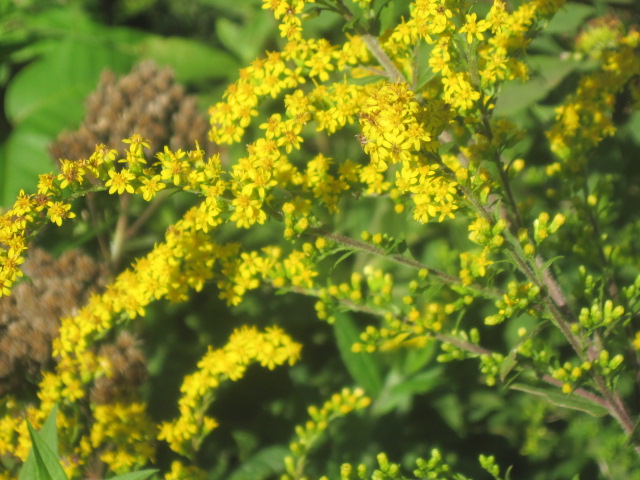
Tall goldenrod, Solidago altissima
Common Name: Tall goldenrod
Scientific Name: Solidago altissima

Family: Asteraceae (Compositae)

There are over 100 different species of goldenrod in the United States, so we had a little challenge identifying goldenrod species.

Goldenrod reminds me of the wildflowers that used to grow along the edge of the railroad tracks behind my house when I was little. Goldenrod makes a deep-colored, strong-
flavored honey.


Annual fleabane, Erigeron annuus

Common Name:
Annual fleabane
Scientific Name: Erigeron annuus
Family: Asteraceae (Compositae)

Fleabane, like goldenrod, has many different native species in the United States. You can tell them apart by the arrangement of the flower heads, and their overall habit, or use this online site for identifying fleabanes. Like other asters, fleabane is a great plant for attracting butterflies, as the adults feed off the nectar in this late-blooming flower, and the larvae find the leaves tasty.
 

Like most asters, this is a late-summer to fall-blooming plant, and provides much-needed food for butterflies and bees as the summer wanes.


Common milkweed, Asclepius syriaca
Common Name: Common milkweed
Scientific Name: Asclepius syriaca
Family: Asclepiadaceae

I love milkweed  (read a childhood story about milkweed here). It gets its common name from the milky sap that oozes from cut stems. Milkweed (along with other species in this family) is one of the favorite all-time foods of the monarch butterfly, with adults enjoying the nectar from the beautiful purple flower heads, and the larvae devouring the leaves.  

Find sources of milkweed seed here.

Rough-stemmed goldenrod, Solidago rugosa
Common Name: Rough-stemmed goldenrod
Scientific Name: Solidago rugosa ssp. rugosa
Family: Asteraceae (Compositae)

Side by side in the same hedgerow, I think we can find five or six different goldenrod species. Here is another representative from our sock walk this month.

Goldenrod has long been used as a source of natural plant dyes, creating a warm yellow color in natural fibers.


Oriental bittersweet, Celastrus orbiculatus

Common Name: Oriental bittersweet
Scientific Name: Celastrus orbiculatus
Family: Celastraceae

Bittersweet is one of those plants that people either love or hate. That is because there are actually two species that you find in New England: one is a wonderful, harmless native plant, and the other is an introduced species that has become quite a noxious weed, especially in hedgerows and reclaimed fields.

It is a perennial vine, but the bright red seeds that are exposed when the yellow or orange shell cracks open are loved by birds, and I think every one germinates, especially if it lands in recently tilled soil.

It is sometimes hard to identify the two bittersweets.  


White clover, Trifolium repens
Common Name: White clover
Scientific Name: Trifolium repens
Family: Fabaceae (Leguminosae)

White clover is another wildflower and meadow flower loved by autumn bees, and it makes a clear yellow honey much milder in taste than the deep-amber honey of the goldenrods.

Clovers  and other legumes are a common addition to forage mixes, and used to be added to grass seed for its ability to fix nitrogen.


Red clover, Trifolium pratense

Common Name: Red clover
Scientific Name: Trifolium pratense
Family: Fabaceae (Leguminosae)

Red clover, like the other clovers, is loved by bees and a common type of autumn honey. If you go to your local farmer's market or orchard to pick apples, you'll likely find a variety of honeys for sale: goldenrod, white and/or  red clover, and mixed wildflower honey are common. You might also find tupelo or other types of honey, depending on the plants available near the hives.

Some folks like to plant fields and other areas not easy to plant, with legumes, such as the clovers. They provide a source of food for bees, butterflies and other wildlife, produce color in an otherwise barren site, and improve the soil.

Meadow evening-primrose, Oenothera pilosella
Common Name: Meadow evening-primrose
Scientific Name: Oenothera pilosella
Family: Onagraceae

Like many of the other wildflowers in this article, there are many (over 120) different species of evening-primrose in North America.

The name, "evening-primrose," is hyphenated, because this plant is not a true primrose, the genus of which would be Primula. Evening-primroses get their common name from their flowering habit: the flowers close during the day, and open up in the late afternoon and early evening hours.

Some evening-primroses have a nice red-purple fall color, as this specimen from our sock walk.


Lanceleaf plantain, Plantago lanceolata

Common Name: Lanceleaf plantain
Scientific Name: Plantago lanceolata
Family: Plantaginaceae

When my eldest son was a little boy, he used to make elaborate cities in the garden, with building made out of sticks and rocks, and roadways for his Matchbox cars. He used to pluck the fruits off the seed heads of plantains, and fill a tiny trailer full of them, pretending they were ears of corn for the market. Too clever!
Plantains are good food to attract butterfly larvae to your garden.


Bishop's flower, Ammi majus
Common Name: Bishop's flower
Scientific Name: Ammi majus
Family: Apiaceae

Queen Anne's lace is a beautiful roadside wildflower. Unfortunately, people who have loved it enough to try to plant it in their yards have often regretted it. This highly invasive species will come up in farm field, flower bed, lawn or anywhere else with soil. Its tap root makes it difficult to rogue out.

Fortunately, there is an annual relative, Bishop's flower, that gives the same affect, seeds enough to establish as a wildflower, but not so much as to invade your entire yard.

Queen Anne's lace is useful for many homespun projects.


Common Name: Poison ivy
Poison ivy, Rhus radicans
Scientific Name: Rhus radicans
Family: Anacardiaceae

We recently went for a walk in the farm pasture, about two weeks after the hay had been cut. We were appalled at the very hearty crop of poison ivy that was coming up over the entire field!

Poison ivy spends most of its life as a vine, but, once mature, forms a shrub, and the birds just love its berries. Hence, the great poison ivy crop in a farm field. The leaves are brilliant red in the fall.

Poison ivy has many poisonous relatives.

Common ragweed, Ambrosia artemisifolia
Common Name: Common ragweed
Scientific Name: Ambrosia artemisifolia
Family: Asteraceae

I come from a long line of hayfever sufferers. Most of us chug through the entire year until about August 20 (here in the Northeast), when we all, suddenly, take ill. This corresponds, within days, to the start of the bloom period for this wildflower, one of the ragweeds. Common ragweed is one of the most common reasons for fall hayfever and allergies.


Big-leaf aster, Eurybia macrophylla

Common Name: Big-leaf aster
Scientific Name: Eurybia macrophylla
Family: Asteraceae (Compositae)

The wild asters are some of my favorite late-summer and early fall wildflowers. Like the garden asters, these bloom all summer, but really show their stuff at the end of the year, when other flowers have given up for the season. For this reason, I rarely rogue them out of my flower beds when they come up: rather, I selectively pull ones that stray from the group, and leave them as fall interest.


We collected a lot of different kinds of plant materials from our socks after our sock walk, including some seeds which we couldn't identify.  We decided to plant one sock (from each pair), but I regret to inform you that the intense rains we had from the remnants of Hurricane Isaac flooded our seed trays. This was great for birdbaths and water dishes for our cats when they didn't feel like coming inside. But it wasn't so great for a follow-up investigation. Better results next time, maybe?

Our investigation...


Oh, well...
That's okay... muddy water always tastes better, says Rosie.


We had a great time with tie dye this summer, using a commercial dye kit. But we have really wanted to try our hand at some natural dyes made from plant materials. Perhaps that will be our next tie dye project? Stay tuned...