Showing posts with label attracting wildlife. Show all posts

Wednesday, January 9, 2013

Starting an Animal Survey: Winter Birds and Friends

Watching Our Birds, All Year Long


We love to watch our birds. With each season, we change our offerings to suit the birds that come with that season: suet for the woodpeckers in the winter; berries and peanuts for the bluebirds in the spring; oranges for the orioles in June; hummingbird nectar for the hummers in July.

It is exciting to see those birds (and other creatures) that signal changes in the seasons. To chronicle the visitors in our yard, we started a year-long animal survey to usher in 2013.
Our survey sheet -- good for a year of viewing! (c) Kim M. Bennett, 2012

We put together an animal survey sheet, where we can list the visitors to our bird feeders, brush pile and water sources, then check off which months we have observed them. To mark shifts in populations, we are entering a number to show the greatest number of each species observed at any given time (similar to what is done to measure relative quantities of birds in Cornell's Project Feeder Watch).

(Click on link to download a copy for your own study.)


The First Week of Our Survey

The first week of January was a busy one. Here is our list of animal visitors (not counting our own pets, of course -- wild animals, only!), in decreasing order of their abundance (NOTE: We noted the maximum number of each animal that was seen at a given time, to monitor the relative abundance of the species for each month):


Dark-eyed juncos were our most abundant visitors this week.
  • Dark-eyed junco (7)
  • Black-capped chickadee (6)
  • Tufted titmouse (4)
  • White-tailed deer (4)
  • White-throat sparrow (4)
  • Blue jay (2)
  • Great horned owl (2)
  • Mourning dove (2)
  • Carolina wren (2)
  • Northern cardinal (2)
  • Chipping sparrow (2)
  • Gray squirrel (2)
  • White-breasted nuthatch (1)
  • Red-bellied woodpecker (1)
  • Downy woodpecker (1)
  • Northern flicker (1)
  • White-crowned sparrow (1)


Nifty Sightings for the Week

Click on the link for more information.
I always love having the chickadees perch inches from my nose and scold me when the feeder runs out of seeds. But there were some other noteworthy observations this week:

... the junco with leucism -- partial albinism that caused its head and cheek feathers to be completely white, and its sides to be tan in color {my youngest son and I spent a lot of time trying to identify it with our field guides before I found a web article about this form of albinism};
... the great horned owls who perched in the hickory overlooking the feeding area during the night time hours and into the dawn, hooting and hunting {our cats are not happy about being kept in at night the past few weeks};
... the pair of wrens that we watched exploring the inner depths of a folded camp chair on our front porch (you know they'll nest anywhere). {My eldest son and I sat in the car after going to the gym, so we wouldn't disturb the busy pair}


What We Offered Our Feathered and Furry Friends

Click on the link for more information.
We had run out of black thistle seed, so we had filled both our tube feeder and the regular feeder with mixed seed, and placed some stale pancakes in a suet feeder (as an alternative to putting them on the ground, which attracts our own dog before the outdoor critters get to the food). We bought some berry-flavored suet dough (loved by the titmice), and threw bread crusts out on the ground.

Read-Alouds to Go With Your Studies

Our two favorite animal books, the Burgess Bird Book for Children and the Burgess Animal Book for Children, are shown here. Click on the links in the captions for more information about these wonderful classics.

[This post was linked to the following blog carnivals:]

Outdoor Hour Challenge ~ Winter Bird: Chickadee
Simple Science Strategies:  Patterns
A Carnival of Homeschooling


Sunday, September 9, 2012

September Wildflowers in Connecticut - Our Sock Walk

As part of our contribution to the September Simple Science Strategies Blog Carnival, my youngest son and I put on our socks (over our shoes, of course!) and headed out to document the steps to a great sock walk. Malik videotaped, and I shot photos, and the two of us are currently trying our hand at compiling these into a video -- no telling how long this will take, but we will be sure to post it for you!

Our sock walk was along the edges of a mixed grass meadow that had been recently harvested, and across the cut meadow to a wet area that the farmer had left uncut. I think this is important, because the kinds of plants we saw on our wildflower walk are either common meadow wildflowers, or noxious agricultural weeds.


Field bindweed, Convulvulus arvensis

Common Name: Field bindweed
Scientific Name: Convulvulus arvensis
Family: Convulvulaceae (the morning-glories)

Field bindweed, or wild morning-glory, has beautiful flowers, but is quite a noxious weed in farm fields, due to the fact that it seeds so mightily, and its vines can grow to 18 feet in a season, overrunning large areas very quickly.

On the plus side, it pulls heavy metal contaminants from soils, and has been used to clean up toxic waste sites in Spain.


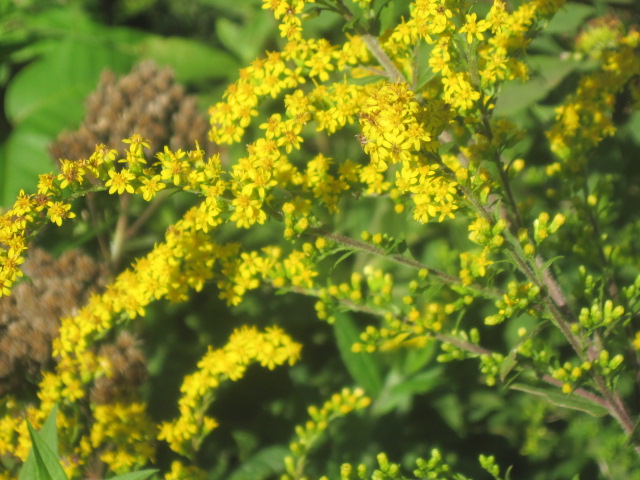
Tall goldenrod, Solidago altissima
Common Name: Tall goldenrod
Scientific Name: Solidago altissima

Family: Asteraceae (Compositae)

There are over 100 different species of goldenrod in the United States, so we had a little challenge identifying goldenrod species.

Goldenrod reminds me of the wildflowers that used to grow along the edge of the railroad tracks behind my house when I was little. Goldenrod makes a deep-colored, strong-
flavored honey.


Annual fleabane, Erigeron annuus

Common Name:
Annual fleabane
Scientific Name: Erigeron annuus
Family: Asteraceae (Compositae)

Fleabane, like goldenrod, has many different native species in the United States. You can tell them apart by the arrangement of the flower heads, and their overall habit, or use this online site for identifying fleabanes. Like other asters, fleabane is a great plant for attracting butterflies, as the adults feed off the nectar in this late-blooming flower, and the larvae find the leaves tasty.
 

Like most asters, this is a late-summer to fall-blooming plant, and provides much-needed food for butterflies and bees as the summer wanes.


Common milkweed, Asclepius syriaca
Common Name: Common milkweed
Scientific Name: Asclepius syriaca
Family: Asclepiadaceae

I love milkweed  (read a childhood story about milkweed here). It gets its common name from the milky sap that oozes from cut stems. Milkweed (along with other species in this family) is one of the favorite all-time foods of the monarch butterfly, with adults enjoying the nectar from the beautiful purple flower heads, and the larvae devouring the leaves.  

Find sources of milkweed seed here.

Rough-stemmed goldenrod, Solidago rugosa
Common Name: Rough-stemmed goldenrod
Scientific Name: Solidago rugosa ssp. rugosa
Family: Asteraceae (Compositae)

Side by side in the same hedgerow, I think we can find five or six different goldenrod species. Here is another representative from our sock walk this month.

Goldenrod has long been used as a source of natural plant dyes, creating a warm yellow color in natural fibers.


Oriental bittersweet, Celastrus orbiculatus

Common Name: Oriental bittersweet
Scientific Name: Celastrus orbiculatus
Family: Celastraceae

Bittersweet is one of those plants that people either love or hate. That is because there are actually two species that you find in New England: one is a wonderful, harmless native plant, and the other is an introduced species that has become quite a noxious weed, especially in hedgerows and reclaimed fields.

It is a perennial vine, but the bright red seeds that are exposed when the yellow or orange shell cracks open are loved by birds, and I think every one germinates, especially if it lands in recently tilled soil.

It is sometimes hard to identify the two bittersweets.  


White clover, Trifolium repens
Common Name: White clover
Scientific Name: Trifolium repens
Family: Fabaceae (Leguminosae)

White clover is another wildflower and meadow flower loved by autumn bees, and it makes a clear yellow honey much milder in taste than the deep-amber honey of the goldenrods.

Clovers  and other legumes are a common addition to forage mixes, and used to be added to grass seed for its ability to fix nitrogen.


Red clover, Trifolium pratense

Common Name: Red clover
Scientific Name: Trifolium pratense
Family: Fabaceae (Leguminosae)

Red clover, like the other clovers, is loved by bees and a common type of autumn honey. If you go to your local farmer's market or orchard to pick apples, you'll likely find a variety of honeys for sale: goldenrod, white and/or  red clover, and mixed wildflower honey are common. You might also find tupelo or other types of honey, depending on the plants available near the hives.

Some folks like to plant fields and other areas not easy to plant, with legumes, such as the clovers. They provide a source of food for bees, butterflies and other wildlife, produce color in an otherwise barren site, and improve the soil.

Meadow evening-primrose, Oenothera pilosella
Common Name: Meadow evening-primrose
Scientific Name: Oenothera pilosella
Family: Onagraceae

Like many of the other wildflowers in this article, there are many (over 120) different species of evening-primrose in North America.

The name, "evening-primrose," is hyphenated, because this plant is not a true primrose, the genus of which would be Primula. Evening-primroses get their common name from their flowering habit: the flowers close during the day, and open up in the late afternoon and early evening hours.

Some evening-primroses have a nice red-purple fall color, as this specimen from our sock walk.


Lanceleaf plantain, Plantago lanceolata

Common Name: Lanceleaf plantain
Scientific Name: Plantago lanceolata
Family: Plantaginaceae

When my eldest son was a little boy, he used to make elaborate cities in the garden, with building made out of sticks and rocks, and roadways for his Matchbox cars. He used to pluck the fruits off the seed heads of plantains, and fill a tiny trailer full of them, pretending they were ears of corn for the market. Too clever!
Plantains are good food to attract butterfly larvae to your garden.


Bishop's flower, Ammi majus
Common Name: Bishop's flower
Scientific Name: Ammi majus
Family: Apiaceae

Queen Anne's lace is a beautiful roadside wildflower. Unfortunately, people who have loved it enough to try to plant it in their yards have often regretted it. This highly invasive species will come up in farm field, flower bed, lawn or anywhere else with soil. Its tap root makes it difficult to rogue out.

Fortunately, there is an annual relative, Bishop's flower, that gives the same affect, seeds enough to establish as a wildflower, but not so much as to invade your entire yard.

Queen Anne's lace is useful for many homespun projects.


Common Name: Poison ivy
Poison ivy, Rhus radicans
Scientific Name: Rhus radicans
Family: Anacardiaceae

We recently went for a walk in the farm pasture, about two weeks after the hay had been cut. We were appalled at the very hearty crop of poison ivy that was coming up over the entire field!

Poison ivy spends most of its life as a vine, but, once mature, forms a shrub, and the birds just love its berries. Hence, the great poison ivy crop in a farm field. The leaves are brilliant red in the fall.

Poison ivy has many poisonous relatives.

Common ragweed, Ambrosia artemisifolia
Common Name: Common ragweed
Scientific Name: Ambrosia artemisifolia
Family: Asteraceae

I come from a long line of hayfever sufferers. Most of us chug through the entire year until about August 20 (here in the Northeast), when we all, suddenly, take ill. This corresponds, within days, to the start of the bloom period for this wildflower, one of the ragweeds. Common ragweed is one of the most common reasons for fall hayfever and allergies.


Big-leaf aster, Eurybia macrophylla

Common Name: Big-leaf aster
Scientific Name: Eurybia macrophylla
Family: Asteraceae (Compositae)

The wild asters are some of my favorite late-summer and early fall wildflowers. Like the garden asters, these bloom all summer, but really show their stuff at the end of the year, when other flowers have given up for the season. For this reason, I rarely rogue them out of my flower beds when they come up: rather, I selectively pull ones that stray from the group, and leave them as fall interest.


We collected a lot of different kinds of plant materials from our socks after our sock walk, including some seeds which we couldn't identify.  We decided to plant one sock (from each pair), but I regret to inform you that the intense rains we had from the remnants of Hurricane Isaac flooded our seed trays. This was great for birdbaths and water dishes for our cats when they didn't feel like coming inside. But it wasn't so great for a follow-up investigation. Better results next time, maybe?

Our investigation...


Oh, well...
That's okay... muddy water always tastes better, says Rosie.


We had a great time with tie dye this summer, using a commercial dye kit. But we have really wanted to try our hand at some natural dyes made from plant materials. Perhaps that will be our next tie dye project? Stay tuned...


Tuesday, September 13, 2011

Feeding the Birds: An Experiment (or Two...)

We just love the birds in our yard. We live in the city, but we have a large lot because our house used to be a multifamily home. We cram as much of the natural world into our yard as we can, and plant it with things that will attract birds and butterflies.

As part of our study of Exploring Creation Through Zoology I: Flying Creatures of the Fifth Day, we conducted an experiment on seed preferences of our backyard birds (Lesson 2: "What Makes a Bird, a Bird?"). This was also a connection to the September Edition of the Handbook of Nature Study Newsletter: Weeds, Seeds and Other Delights. Here is how to conduct it in your backyard:
_________________________________________________________

Materials:

  • 2 styrofoam plates or 2 other identical "feeders"
  • 2 kinds of seeds (we used black oil sunflower seed and Niger thistle seed)
Note: We reviewed the terms dependent variable (seed preference) and independent variable (seed type), and introduced a new term, confounding. We reviewed the importance of having only one independent variable (the kind of seed), so it is very important that the feeders are the same. Otherwise, the difference in the feeders will introduce confounding into your experiment.
_________________________________________________________


Procedure:
  • Place the feeders in an open space where they can be viewed.
  • Observe them, keeping track of how many visits each feeder gets. We observed our feeders over the following several days, and made a simple tally chart to record visits. As an extra, we decided to record the species of birds who visited each feeder, as well.
A little word on the experiments in Apologia Science's Young Explorers Series, from the scientist-mom:


When you conduct an experiment, you are testing to see the effect of you independent variable (here, seed type) on the dependent variable (seed preference).  In order to measure this, you are assuming that any differences in seed preference are ONLY due to the independent variable-- so you must make sure there are no other factors that could affect the dependent variable. If we put one feeder in a wide open space, and one under a shrub, then we introduce another factor which would affect birds' preference in the seed (i.e., availability of cover), and we can't say that the results were only due to the type of seed.

You will notice that the experiments in the Young Explorers Series (for elementary students) very simple and use common items. This is deliberate, so that you spend more time reviewing the principles and the scientific method. The directions for each experiment include a discussion of "big kid" scientific terms and concepts, and concentrate on methodology, rather than complicated equipment or steps, letting your child spend more time on the actual inquiry part of science.

When children are older (middle and high school), we will want them to follow complex, multistep procedures with precision. This is a skill, by itself. So, for now, we are keeping the procedures simple, so we can concentrate on the components of the scientific method.
_________________________________________________________

Hypothesis:

  • Null Hypothesis: Seed type has no effect on the number of visits to each feeder.
  • Alternative Hypothesis: The type of seed affects the number of visits to each feeder.
Maliks' hypothesis: "I think the thistle seed will get more likes."
_________________________________________________________

Results:

Here is how we set up our data table, and our results:


Niger Thistle Seed

Black Oil Sunflower Seed


English (House) Sparrow – II


Northern Cardinal – II
Mourning Dove – I


_________________________________________________________

 Conclusion:

We  accepted our alternative hypothesis, that the type of seed influences bird seed preferences in our yard. Malik also concluded that different birds prefer different types of seed.

Sometimes, a picture says it all.
 _________________________________________________________


In a research paper, scientists then include a section called Discussion, where the scientist talks about the particulars of an experiment, what surprised him (or her), what didn't go as planned, and what adjustments would be made next time, to better test the hypothesis. This is also the section where the researcher tells what next experiments should be done, as a result of these findings. This section was not included in the lab report from the Apologia materials, but we included it. Here are the three areas that might have affected our results.

1. Human activities. When we first set up our experiment, my son asked, "But won't the birds fly away every time we open the screen door?" In fact, we did notice this, and it was challenging to actually catch the birds feeding, although it was clear they did.

2. Cat activities. As Malik put it in his conclusion, "The cats were on the ground, and so were the feeders."

3. Feeder location. We saw that the types of birds that came to the feeders were birds that don't mind feeding on the ground. My son expected goldfinches to come to the thistle seed, since we see them on the thistle feeder all the time, but they do not feed on the ground, and we didn't observe them.

We would repeat this experiment by hanging the feeders where we could observe them through a window.

_________________________________________________________

In the photo, above, you can see the net bag that used to contain our Smart Suet. It was very popular with the birds (but a little soft in the heat -- we'll put the rest out once the weather gets cold). They pulled it off the hanger and finished it off.

The Handbook of Nature Study has some helpful hints about how to turn your yard into a haven for nature (pp. 43-44), and for the basics of beginning bird study with young children (p. 28). See also Barbara McCoy's blog by the same name, Handbook of Nature Study, for an article on Making Your Yard a Wildlife Habitat.


Wednesday, August 31, 2011

Feeding Our Hungry Bird Friends after Hurricane Irene

What a wild week it's been here on the East Coast!

We should have known we were in for something big when we got up on Saturday morning. My eldest son, Evan (who notices these things, and who gets up early like his mother) called me very early on Saturday and said, "Go outside, quickly, and look to the East."  The sky was absolutely breath-taking (this photo doesn't even approach what we saw).  What's that old chestnut?

Red at night -- traveler's delight;
Red in the morning -- travelers, take warning.

We spent much of Saturday securing anything that my husband hadn't secured during the week, filling buckets of water, and scouring the Eastern Seaboard for D batteries (some of you can probably relate). Among the items that we put away were all of our bird feeders.

The birds, who sensed the weather was turning, came in droves to the space where the feeders used to be, and scoured the ground for scattered seeds, even into the beginning of the day on Sunday. I felt bad for them. When the weather started getting really wild, they found places to hide from the wind and rain.

We were extremely fortunate in our city, where we did not lose power (about 500,000 CT residents did, and about 400,000 still are awaiting power in their homes). We have debris to clean up, but did not sustain the damage that many folks along the coast, and even in neighboring towns, and even other parts of our city, did. 
_________________________________________________

We are studying Exploring Creation Through Zoology I: Flying Creatures of the Fifth Day for part of our science curriculum this year. Part of Lesson 2 ("What Makes a Bird a Bird?") involves making a number of feeders for birds.  After we refilled and replaced our bird feeders (to the delight of our birdy friends), we enjoyed a cooking project yesterday, making our own "smart suet."

Smart Suet
  • Small zippered plastic storage bags (we used mini loaf pans instead)
  • Mesh bag (an old onion bag works well), or suet basket (we have two of these)
  • Stove
  • Large pot
  • Wooden spoon
  • Freezer
  • 2 c crunchy peanut butter
  • 2 c lard (not vegetable shortening)
  • 4 c rolled oats (the "old-fashioned" or long-cooking kind, not quick oats)
  • 4 c cornmeal
  • 2/3 c sugar
  • 1 c raisins
  • 1 c bird seed or other whole grains

  1. Melt lard and peanut butter in a large pot over low heat.
  2. Stir in oats, cornmeal, sugar, raisins and bird seed.
  3. Scoop mixture into small plastic zipper-type storage bags. Zip closed.
  4. Place bags in freezer until hard (overnight).
  5. When you want to feed the birds, remove suet from one of the bags, and place in mesh bag or suet basket.
 You can vary the recipe by adding different items to the mix. See which birds come to each flavor.
  • Orange-fruit Suet: Omit peanut butter, and double lard. Add dried blueberries (1 c) and 3 tsp orange flavoring or 1/4 c. of shredded, dried orange peel.
  • Very Berry Suet: Omit peanut butter, and double lard. Add 1 - 2 c. dried berries (combination of blueberries, raspberries and cherries) to the raisins in the mixture.
  • Bug Lovers Suet: Make as above, omitting raisins. Add 2 c dried mealworms (available in the bird seed aisle of Lowes or Home Depot) to the mixture. [Mealworms are a big hit with lots of birds, even ones who are normally seed eaters -- a very nutritious, high-fat treat for winter feeding].

One thing to note: if the weather is still very hot where you live, you might wait until fall to start suet feeding, as the mixture will melt if the temperature is very hot all day.


My friend, Barbara McCoy, gives some great pointers on Making Your Backyard a Wildlife Habitat.  Why not add some nature study and observations to your day? Donna Young has created some beautiful Nature Journal pages to download and place in your binder. See also the incredible assortment of nature study notebooking pages at the Notebooking Treasury:

Not sure where to begin? Begin at the beginning, with Outdoor Hour Challenge #1: Let's Get Started (like we did!).

Let us know how you began using nature study with your children or students. Use Mr. Linky (below) to post the link to your blog entry (not the whole page, but the specific entry) and make sure that you leave a comment, below, too!


________________________________________________

As you go through your day today, please keep all those who have been affected by Hurricane Irene in your thoughts, hearts and prayers. And take time to thank God for the things you have right now. May God bless you richly!


Follow Me on Pinterest