Monday, January 21, 2013

A Winter Battle Re-enactment


Today was a very relaxed day in our household. We had breakfast for lunch (hash browns, maple-y bacon, scrambled eggs and homemade lemonade... mmm...), filled the bird feeders and sorted some laundry for future washing, later tonight. My little guy and I spent time sorting LEGOs for a blog post on patterns, and then he spent the remainder of the afternoon creating and filming World War II battles in the back yard, using a slew of little plastic Army men he has collected over the years.

While he was working, it began to snow. It made for cold working conditions, but added to the authenticity of his little battle scenes.


Here is a photo log of his afternoon (guest "blogged" by the cinematographer, himself)... We submitted this post to both Carnival of Homeschooling and Top Ten Tuesday.


Top Ten Tuesday at Many Little Blessings


Ten Helpful Hints to Make a Perfect Stop-Motion Battle Re-enactment

by Guest Blogger, Malik B., Age 9


Hint #1:

The key to stop motion is to have a camera with plenty of memory space, because you will need to take a LOT of pictures. If you run out of room in the beginning, it will take you a long time to delete extra pictures.

I have a V-Tech Kidzoom camera. It holds thousands of pictures and also takes videos.

Videos take a lot of space out of your memory, so I recommend not to have videos on your camera when you want to take stop motion photos.

It was very cold and snowing, so I decided to name the movie, Plastic Army Men: The Cold War.


Hint #2:

The second thing you need to know is how to do stop motion. The way most people do it is to take a picture, move the figure a little bit in the direction you want it to go, then take another picture. When you're in Microsoft Movie Editor, and you put the photos together, it will look like the guy is gliding right across the screen.

If you want to see a great stop motion video, look up Plastic Apocalypse, by Theakker3B.


Hint #3:

The next thing you should know is how to make home-made special effects. I learned how to do these things by watching a You Tube video called, The Making of 'Bricks of War,' by Kooberz.

In the video, he shows a clip of how he makes "blood" splatter on his lens without messing up his camera lens. He suggested placing plastic wrap in front of your lens to cover it.


Hint #4:

For blood spatter on the lens, I put paint on the plastic wrap covering the lens. You can also use red clay, which sticks better, but doesn't look as realistic as the watery paint.

Since it was very cold outside, my paint wash container became a slushy, and the wet paint froze, too. I had to breathe on it to thaw it.


Hint #5:


This is what the picture of the blood spatter effect looks like, after I took the picture of the tan soldier (hint #4).

I realized I used a little too much paint, so I deleted this photo and took another one. If you wait to check when you get ready to edit, it's too difficult to set up your scene perfect again.


Hint #6:

Like my favorite filmer, Theakker3B, I take various natural objects and turn them into other objects. Because I didn't have a plastic sniper post, I took the open cabin on my truck (see Hint #2) and used three sticks, taped together, to make a platform that I put on top of the cabin.

If you don't have something, you can always make a makeshift version.


Hint #7:

This is the inside of one of my Army men storage containers. It's a mixture of landscape items, plus tan and green soldiers.

Another key to stop motion battle scenes, depending on your scene, is to always have lots of Army men available, plus paint and water if you like my idea for the special effects.


Hint #8:

Here you can see that I have several tan soldiers out. Some of them are covered in red paint, due to "battle injuries."

Sometimes I have broken pieces off my Army men, to make battle scenes look more realistic. Or, if you don't want to destroy your things, you can use two identical men, bury the chest and head of one partway in the dirt, then bury the legs of another in the dirt.


Hint #9:

It's always nice to have an audience while you work. This is one of my cats, Cody Bear, who is watching me work from under the patio table.

Notice that she is getting covered with snow.

My mom was also watching as she filled the bird feeders.


Hint #10:

[From Mom!]

You go through a lot of batteries during this process, so stock up.

We discovered that you can buy bags of plastic Army men for a dollar at most dollar stores. We have tan, green and some pink (?) ones, plus a few blue. It's ok to have multiple sets -- you just make bigger armies.


***There's Still Time!***

Don't forget about the Mid-Winter Give-away...

Click over for more details on how to enter!


Wednesday, January 9, 2013

Time for a Winter Give-away!

Courtesy of our sister site, Simple Science Strategies, here is a great give-away to bring in the new year:

a Rafflecopter giveaway

See "Time for a Mid-Winter Give-away!" for more details about these two great e-Books.

Starting an Animal Survey: Winter Birds and Friends

Watching Our Birds, All Year Long


We love to watch our birds. With each season, we change our offerings to suit the birds that come with that season: suet for the woodpeckers in the winter; berries and peanuts for the bluebirds in the spring; oranges for the orioles in June; hummingbird nectar for the hummers in July.

It is exciting to see those birds (and other creatures) that signal changes in the seasons. To chronicle the visitors in our yard, we started a year-long animal survey to usher in 2013.
Our survey sheet -- good for a year of viewing! (c) Kim M. Bennett, 2012

We put together an animal survey sheet, where we can list the visitors to our bird feeders, brush pile and water sources, then check off which months we have observed them. To mark shifts in populations, we are entering a number to show the greatest number of each species observed at any given time (similar to what is done to measure relative quantities of birds in Cornell's Project Feeder Watch).

(Click on link to download a copy for your own study.)


The First Week of Our Survey

The first week of January was a busy one. Here is our list of animal visitors (not counting our own pets, of course -- wild animals, only!), in decreasing order of their abundance (NOTE: We noted the maximum number of each animal that was seen at a given time, to monitor the relative abundance of the species for each month):


Dark-eyed juncos were our most abundant visitors this week.
  • Dark-eyed junco (7)
  • Black-capped chickadee (6)
  • Tufted titmouse (4)
  • White-tailed deer (4)
  • White-throat sparrow (4)
  • Blue jay (2)
  • Great horned owl (2)
  • Mourning dove (2)
  • Carolina wren (2)
  • Northern cardinal (2)
  • Chipping sparrow (2)
  • Gray squirrel (2)
  • White-breasted nuthatch (1)
  • Red-bellied woodpecker (1)
  • Downy woodpecker (1)
  • Northern flicker (1)
  • White-crowned sparrow (1)


Nifty Sightings for the Week

Click on the link for more information.
I always love having the chickadees perch inches from my nose and scold me when the feeder runs out of seeds. But there were some other noteworthy observations this week:

... the junco with leucism -- partial albinism that caused its head and cheek feathers to be completely white, and its sides to be tan in color {my youngest son and I spent a lot of time trying to identify it with our field guides before I found a web article about this form of albinism};
... the great horned owls who perched in the hickory overlooking the feeding area during the night time hours and into the dawn, hooting and hunting {our cats are not happy about being kept in at night the past few weeks};
... the pair of wrens that we watched exploring the inner depths of a folded camp chair on our front porch (you know they'll nest anywhere). {My eldest son and I sat in the car after going to the gym, so we wouldn't disturb the busy pair}


What We Offered Our Feathered and Furry Friends

Click on the link for more information.
We had run out of black thistle seed, so we had filled both our tube feeder and the regular feeder with mixed seed, and placed some stale pancakes in a suet feeder (as an alternative to putting them on the ground, which attracts our own dog before the outdoor critters get to the food). We bought some berry-flavored suet dough (loved by the titmice), and threw bread crusts out on the ground.

Read-Alouds to Go With Your Studies

Our two favorite animal books, the Burgess Bird Book for Children and the Burgess Animal Book for Children, are shown here. Click on the links in the captions for more information about these wonderful classics.

[This post was linked to the following blog carnivals:]

Outdoor Hour Challenge ~ Winter Bird: Chickadee
Simple Science Strategies:  Patterns
A Carnival of Homeschooling


Thursday, December 20, 2012

Squirrel and Bird Nest Study

Bare trees reveal squirrel nests. (c) Kim M. Bennett, 2012.

Last month, we spent a lot of time exploring the world of fall, seeing treasures revealed when the leaves fall off the trees. One unexpected sighting was a massive squirrels' nest, in a red oak near our driveway.

Our discovery led my youngest son to request that we re-read The Burgess Animal Book for Children (BABC), from the beginning. If you are following along in BABC, this study would accompany the section on squirrels (the third "study" in the book).

Read along for a nature study on squirrels nests, which includes many ideas we've used over the years.


Read-Alouds:

Our favorite animal study read-aloud!
Sometimes our natures studies happen by accident (such as our discovery of this squirrel's nest). Other times, a read-aloud piques our interest. Our favorite nature study read-aloud is The Burgess Animal Book for Children. And it fits perfectly as a read-aloud if you are using the Exploring Creation through Zoology series, which focus on animal classification, as the BABC chapters are laid out to introduce children to animals as they are related to one another. And who doesn't like Peter Rabbit?

If you want to fill a book basket with books to go along with this study, here are some of our family favorites:

  • The Tale of Squirrel Nutkin, by Beatrix Potter (my youngest brother was a big Beatrix Potter fan)
  • Miss Suzy, by Miriam Young (my own childhood favorite) 
  • Rakkety Tam (Redwall Series #17), by Brian Jacques (a favorite of my eldest son)
  • Nuts to You!, by Lois Ehlert (all my kids loved Lois Ehlert's collage illustrations - a great thing to try for your creative arts connections, if you use the "Five in a Row" approach to homeschooling)
For our squirrel nest study, we just enjoyed Chapters 4-8 of  The Burgess Animal Book for Children. Again!


My little guy grew up surrounded by technology, and enjoys reading books on our NOOK Color. The e-Books compatible with the NOOK are available at Barnes & Noble. We noticed that there are several free ones with great photos of squirrels:

If you don't have an e-Reader, you will love the NOOK products. (My youngest son uses it to listen to Pandora, watch videos, read books and do research). There are many apps available for our favorite online resources (Pinterest, Dictionary.com, Ancestry.com, etc), so it functions as a nice little mobile device when we don't want to carry the laptop.


Lesson Ideas:

Gray squirrel nest (c) Kim M. Bennett 2012
We discovered the squirrel nest as one nest among three we found the same week: the other two were an oriole nest and an unidentified warbler nest. So it made sense to compare the three nests as part of our study.

We studied the two bird nests on the front porch (the squirrel nest, of course, was WAY up in a tree), discussing their similarities and differences, but you could also use a double bubble map (see "Comparing Nests: The 'Same and Different' Center" for examples of how to use a double bubble map with individual students or groups of students, or in a classroom).

We love the Exploring Creation series, and are using Land Animals of the Sixth Day this year. Pages 113-118 cover "Mouse-Like Rodents," including the squirrels. The material is very much like that of the BABC.


Nest of the Northern Oriole (c) Kim M. Bennett 2012
Our other "go-to" resource, the Handbook of Nature Study, discusses the nesting habits of red squirrels on p. 235. We have mostly gray squirrels in our area. Red squirrels like forests with more evergreen trees -- our forests are mostly oaks and maples.


Click image for more info.
When we first started homeschooling several years ago, I read that many homeschoolers used this book as part of their homeschool nature study work. I borrowed it from the local library, but soon decided that it was well worth the approximately $25 it costs to buy a used copy on the Internet. Buy it!

Other Resources:

My son and I created a set of notebooking pages to use in conjunction with our squirrel study. Since he was already working on another writing project, we mostly used the organizing tools (have I told you before that my son is NOT an avid notebooking enthusiast? He would rather fill notebooks full of action stories, so I choose my battles carefully...)

Nests, Nests, Nests!, a 25-page resource. $1.95
"Nests, Nests, Nests!" reviews the e-Book that we created to go along with this study. This set includes both primary and regular-ruled science journaling pages focusing on animal nests, as well as a variety of framed pages for thematic writing, note-taking or nature study. Organizers for studying and comparing nests of different animal orders, coloring and copywork pages, and game cards for sorting and classification tasks make this set versatile, perfect for direct instruction or independent learning tasks. You may also download a free sample of some of the pages.

The resources also include copywork, which you can see to the right. We chose scripture from Genesis, as that we are using Genesis through Deuteronomy and Ancient Egypt, from Simply Charlotte Mason, for our Bible Study curriculum, and are currently reading Genesis. We are used to using scriptures for copywork, since that is what is used with the Exploring Creation texts.


Discussion Ideas:

Here are some of the discussion questions we used when studying about nests (I've marked each one to show what science discipline it relates to -- physical sciences, life sciences, earth and space sciences, or engineering, technology and the application of science):
  1. What types of materials do different types of animals use in their nests? (L)
  2. How do these materials differ from one another? How are they the same? (P)
  3. What makes these materials useful for nest-building? (E)
  4. What different ways do animals build their nests? (L)
  5. How are different kinds of animals adapted to obtain protection where they live? (L)
  6. How might natural phenomena (such as winter storms) and human activities (such as tree cutting and clearing for building) cause changes in animal nesting behaviors? (E)
For those of you with children at multiple ages in your home, these questions follow a general progression from K to grade 4, as you move down the list. But don't get stuck on that -- my son (a fourth grader) was fascinated with seeing (up close) the actual materials used for each nest, and for different parts of the nest (for example, the warbler nest was a very tight cup of birch bark, leaf pieces and grape vine bark, but it was lined so neatly with tightly packed pine needles -- fascinating. Learning is what you make of it.

Unidentified warbler nest from M's collection. (c) Kim M. Bennett 2012

Inside lined with tightly packed white pine needles. (c) Kim M. Bennett 2012

Outside was formed with bits of bark from paper birch. (c) Kim M. Bennett, 2012


We Love to Share...

This post and our ideas was shared on the Outdoor Hour Challenge and Simple Science Strategies Blog Carnivals.

Blog


Monday, November 19, 2012

My First Ten Book Additions to Shelfari!

I discovered Shelfari on a friend's blog just moments ago...

So my weekly edition to the Top Ten Tuesday Blog Carnival is my...

First Ten Books on Shelfari!

Top Ten Tuesday at Many Little Blessings

These happen to be the books we are using for homeschool studies (with the exception of two, which don't show up on Shelfari). If you are new to homeschooling, we would highly recommend these as additions to your library.

Now that I know how to "work" Shelfari, I will be adding other books that we have read (or are reading) for homeschool. So check back often!

Look for the widget on the sidebar (you can't miss it -- it looks like a bookshelf!). Or check out the widget in this post (below). Want your own bookshelf? Check out the link at the bottom of the widget. It's so easy, and updates as you add books. You can filter what is visible by tags (in case you only want your bird books to show, for example), by whether they are on your wish list or are ones you already have read... Very versatile.


And We Have a Composter Winner!

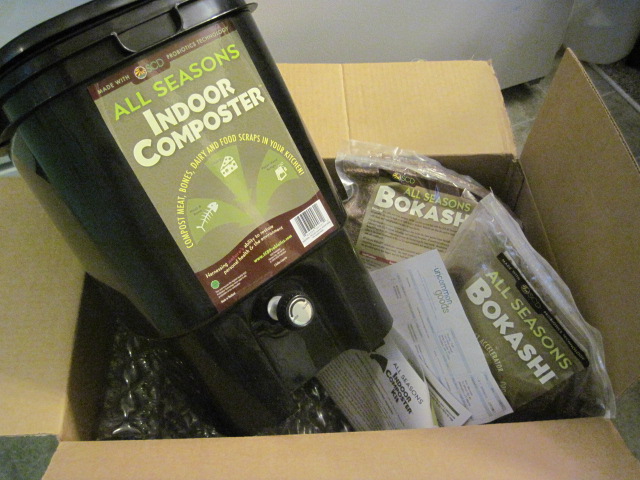
Thank you to participants in last month's Rafflecopter Giveaway of an All Season Indoor Composter, by UncommonGoods... and the winner is...

Kathy Schoenherr

Stay tuned for an after-the-holidays giveaway. And have a Happy Thanksgiving, everyone!


~Kim @ A Child's Garden