Showing posts with label September. Show all posts

Sunday, September 9, 2012

September Wildflowers in Connecticut - Our Sock Walk

As part of our contribution to the September Simple Science Strategies Blog Carnival, my youngest son and I put on our socks (over our shoes, of course!) and headed out to document the steps to a great sock walk. Malik videotaped, and I shot photos, and the two of us are currently trying our hand at compiling these into a video -- no telling how long this will take, but we will be sure to post it for you!

Our sock walk was along the edges of a mixed grass meadow that had been recently harvested, and across the cut meadow to a wet area that the farmer had left uncut. I think this is important, because the kinds of plants we saw on our wildflower walk are either common meadow wildflowers, or noxious agricultural weeds.


Field bindweed, Convulvulus arvensis

Common Name: Field bindweed
Scientific Name: Convulvulus arvensis
Family: Convulvulaceae (the morning-glories)

Field bindweed, or wild morning-glory, has beautiful flowers, but is quite a noxious weed in farm fields, due to the fact that it seeds so mightily, and its vines can grow to 18 feet in a season, overrunning large areas very quickly.

On the plus side, it pulls heavy metal contaminants from soils, and has been used to clean up toxic waste sites in Spain.
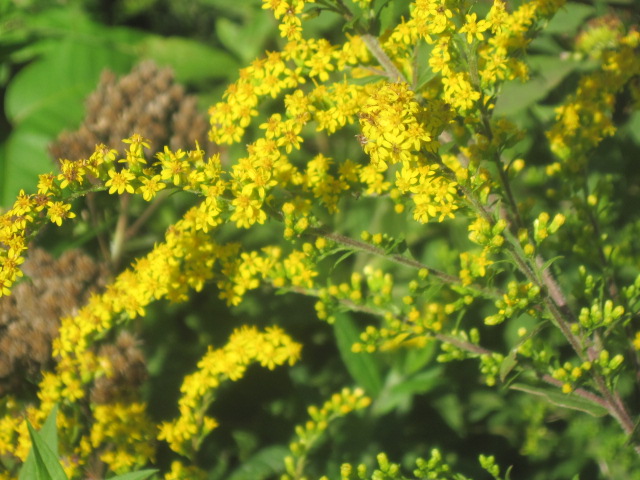


Tall goldenrod, Solidago altissima
Common Name: Tall goldenrod
Scientific Name: Solidago altissima

Family: Asteraceae (Compositae)

There are over 100 different species of goldenrod in the United States, so we had a little challenge identifying goldenrod species.

Goldenrod reminds me of the wildflowers that used to grow along the edge of the railroad tracks behind my house when I was little. Goldenrod makes a deep-colored, strong-
flavored honey.


Annual fleabane, Erigeron annuus

Common Name:
Annual fleabane
Scientific Name: Erigeron annuus
Family: Asteraceae (Compositae)

Fleabane, like goldenrod, has many different native species in the United States. You can tell them apart by the arrangement of the flower heads, and their overall habit, or use this online site for identifying fleabanes. Like other asters, fleabane is a great plant for attracting butterflies, as the adults feed off the nectar in this late-blooming flower, and the larvae find the leaves tasty.
 

Like most asters, this is a late-summer to fall-blooming plant, and provides much-needed food for butterflies and bees as the summer wanes.


Common milkweed, Asclepius syriaca
Common Name: Common milkweed
Scientific Name: Asclepius syriaca
Family: Asclepiadaceae

I love milkweed  (read a childhood story about milkweed here). It gets its common name from the milky sap that oozes from cut stems. Milkweed (along with other species in this family) is one of the favorite all-time foods of the monarch butterfly, with adults enjoying the nectar from the beautiful purple flower heads, and the larvae devouring the leaves.  

Find sources of milkweed seed here.

Rough-stemmed goldenrod, Solidago rugosa
Common Name: Rough-stemmed goldenrod
Scientific Name: Solidago rugosa ssp. rugosa
Family: Asteraceae (Compositae)

Side by side in the same hedgerow, I think we can find five or six different goldenrod species. Here is another representative from our sock walk this month.

Goldenrod has long been used as a source of natural plant dyes, creating a warm yellow color in natural fibers.


Oriental bittersweet, Celastrus orbiculatus

Common Name: Oriental bittersweet
Scientific Name: Celastrus orbiculatus
Family: Celastraceae

Bittersweet is one of those plants that people either love or hate. That is because there are actually two species that you find in New England: one is a wonderful, harmless native plant, and the other is an introduced species that has become quite a noxious weed, especially in hedgerows and reclaimed fields.

It is a perennial vine, but the bright red seeds that are exposed when the yellow or orange shell cracks open are loved by birds, and I think every one germinates, especially if it lands in recently tilled soil.

It is sometimes hard to identify the two bittersweets.  


White clover, Trifolium repens
Common Name: White clover
Scientific Name: Trifolium repens
Family: Fabaceae (Leguminosae)

White clover is another wildflower and meadow flower loved by autumn bees, and it makes a clear yellow honey much milder in taste than the deep-amber honey of the goldenrods.

Clovers  and other legumes are a common addition to forage mixes, and used to be added to grass seed for its ability to fix nitrogen.


Red clover, Trifolium pratense

Common Name: Red clover
Scientific Name: Trifolium pratense
Family: Fabaceae (Leguminosae)

Red clover, like the other clovers, is loved by bees and a common type of autumn honey. If you go to your local farmer's market or orchard to pick apples, you'll likely find a variety of honeys for sale: goldenrod, white and/or  red clover, and mixed wildflower honey are common. You might also find tupelo or other types of honey, depending on the plants available near the hives.

Some folks like to plant fields and other areas not easy to plant, with legumes, such as the clovers. They provide a source of food for bees, butterflies and other wildlife, produce color in an otherwise barren site, and improve the soil.

Meadow evening-primrose, Oenothera pilosella
Common Name: Meadow evening-primrose
Scientific Name: Oenothera pilosella
Family: Onagraceae

Like many of the other wildflowers in this article, there are many (over 120) different species of evening-primrose in North America.

The name, "evening-primrose," is hyphenated, because this plant is not a true primrose, the genus of which would be Primula. Evening-primroses get their common name from their flowering habit: the flowers close during the day, and open up in the late afternoon and early evening hours.

Some evening-primroses have a nice red-purple fall color, as this specimen from our sock walk.


Lanceleaf plantain, Plantago lanceolata

Common Name: Lanceleaf plantain
Scientific Name: Plantago lanceolata
Family: Plantaginaceae

When my eldest son was a little boy, he used to make elaborate cities in the garden, with building made out of sticks and rocks, and roadways for his Matchbox cars. He used to pluck the fruits off the seed heads of plantains, and fill a tiny trailer full of them, pretending they were ears of corn for the market. Too clever!
Plantains are good food to attract butterfly larvae to your garden.


Bishop's flower, Ammi majus
Common Name: Bishop's flower
Scientific Name: Ammi majus
Family: Apiaceae

Queen Anne's lace is a beautiful roadside wildflower. Unfortunately, people who have loved it enough to try to plant it in their yards have often regretted it. This highly invasive species will come up in farm field, flower bed, lawn or anywhere else with soil. Its tap root makes it difficult to rogue out.

Fortunately, there is an annual relative, Bishop's flower, that gives the same affect, seeds enough to establish as a wildflower, but not so much as to invade your entire yard.

Queen Anne's lace is useful for many homespun projects.


Common Name: Poison ivy
Poison ivy, Rhus radicans
Scientific Name: Rhus radicans
Family: Anacardiaceae

We recently went for a walk in the farm pasture, about two weeks after the hay had been cut. We were appalled at the very hearty crop of poison ivy that was coming up over the entire field!

Poison ivy spends most of its life as a vine, but, once mature, forms a shrub, and the birds just love its berries. Hence, the great poison ivy crop in a farm field. The leaves are brilliant red in the fall.

Poison ivy has many poisonous relatives.

Common ragweed, Ambrosia artemisifolia
Common Name: Common ragweed
Scientific Name: Ambrosia artemisifolia
Family: Asteraceae

I come from a long line of hayfever sufferers. Most of us chug through the entire year until about August 20 (here in the Northeast), when we all, suddenly, take ill. This corresponds, within days, to the start of the bloom period for this wildflower, one of the ragweeds. Common ragweed is one of the most common reasons for fall hayfever and allergies.


Big-leaf aster, Eurybia macrophylla

Common Name: Big-leaf aster
Scientific Name: Eurybia macrophylla
Family: Asteraceae (Compositae)

The wild asters are some of my favorite late-summer and early fall wildflowers. Like the garden asters, these bloom all summer, but really show their stuff at the end of the year, when other flowers have given up for the season. For this reason, I rarely rogue them out of my flower beds when they come up: rather, I selectively pull ones that stray from the group, and leave them as fall interest.


We collected a lot of different kinds of plant materials from our socks after our sock walk, including some seeds which we couldn't identify.  We decided to plant one sock (from each pair), but I regret to inform you that the intense rains we had from the remnants of Hurricane Isaac flooded our seed trays. This was great for birdbaths and water dishes for our cats when they didn't feel like coming inside. But it wasn't so great for a follow-up investigation. Better results next time, maybe?

Our investigation...


Oh, well...
That's okay... muddy water always tastes better, says Rosie.


We had a great time with tie dye this summer, using a commercial dye kit. But we have really wanted to try our hand at some natural dyes made from plant materials. Perhaps that will be our next tie dye project? Stay tuned...


Sunday, July 29, 2012

NEW! Botany Notebooking Pages for Fall...

[Re-blogged from Books and Blooms]

Right now, in New England, we've pretty much finished picking strawberries, and are now heading into blueberry season. It will be a minute before we will be out collecting bags of apples.

But I noticed at Wal-Mart the other day, that there are shelves and shelves of notebooks and lunchboxes on display, and I just got my son's school supply list from his fourth grade teacher, so can September be too far off?

For those of you preparing curriculum for the fall, come see my new science journaling pages.

"An Apple a Day" is the first in a series of science journaling pages that follows the  apple tree throughout the year. This first set focuses on the formation of the apple fruit from the flower.

The next set will focus on the fall colors of fruits and leaves.

For more information, see the Store at Simple Science Strategies.
See Simple Science Strategies for details!

Saturday, October 1, 2011

Make Room for Mushrooms

Fungi are a great fall study.
[Originally published 2011 - posted to Simple Science Strategies Blog Carnival, September 2012 Edition]

  
On the news this morning, the weatherman said that we were 4 inches over our monthly average for rainfall, for September, and a whopping 20 inches over for the year, with the rainiest weather, and a chunk of snow, yet to come. No wonder I can't get my towels to dry!

The rain and our warmer than normal temperatures have produced an astonishing assortment of mushrooms, molds and other sorts of fungi and friends, and we've enjoyed greeting the newcomers each morning.

Here is a photocollage of our fall mushroom sitings, as well as some other creatures that are related to mushrooms, and some that aren't related at all! Come along...

Bracket and shelf fungi grow on dead trees.
Bracket (shelf) fungi are woody and tough, and grow on dead branches and tree trunks. Large ones, called artist conks, have a broad underside that darkens when etched with a sharp tool. They have been used as "palettes" by artists, because they dry and can be preserved indefinitely.

Bracket fungi are perennial -- you can observe growth rings in their flesh, especially on the larger ones. Individual specimens from 50-70 years of age have been collected. That's incredible!

Wayne's World has some great information on bracket fungi.

Indian-pipes are true plants.
If you are out on a mushroom hunt, you will probably spot these interesting specimens, called Indian-pipes. Although they look like fungi, they are actually true plants, but ones without any chlorophyll, the green pigment that allows plants to make their own food from sunlight. I have included them in this article, not just because they look like mushrooms, but because they depend on fungi to live.

Indian-pipes grown in woodland areas with a lot of dead and decaying leaves. However, unlike mushrooms and other fungi, Indian-pipes cannot digest the decaying leaves for food. And, as we already established, they cannot make their own food from carbon dioxide and sunlight. So the roots of the Indian-pipes grow on the mycelium (the hairy, underground "roots" of mushrooms) that live in harmony with the roots of some kinds of woodland trees (called mycorrhizal fungi). The fungus gets its food by digesting decaying plant materials, and the Indian-pipes siphon a little off for themselves. Ingenious!

Rare red form of Indian-pipes


We spotted a lot of Indian-pipes, but were thrilled to spot something I had never seen before -- a rare red variant of the Indian-pipes. I am not sure if it is localized, but there was a lot of it in the park where we hiked.

Indian-pipes turn black when they die back, but still look interesting.

Next time you are hiking in the late summer or early fall, look under pines, birches and other forest trees for these interesting, non-green plants.

Check out the great photos of Indian-pipes from Fairfax County Public School's website.

Mushroom that reminded me of shiitakes.


We spotted an interesting kind of fungus growing on the decaying trunk of a dead tree. It was not a bracket fungus, but a button type of mushroom. It reminded me very much of shiitake mushrooms.

Did you know that you can grow your own shiitake mushrooms, right in your back yard?  Shiitakes like to grow on wood, and all they really need is a wood pile and occasional watering. You can find lots of shiitake growing kits (minus the wood!) online, and can read more about how to grow shiitake mushrooms on the Mother Earth News website. This is actually on our list of things to try in our backyard (we have a beautiful saucer magnolia that creates too much shade for growing plants in one part of the yard, but would make a great mushroom shelter!). We'll keep you all posted!


We called this "The Puffball Stomp"
 Puffballs never cease to fascinate me. They come in all sizes, from the quarter-sized ones in the photo to the right, to ones the size of a dinner plate, as in the lead paragraphs of this article. My father-in-law used to collect larger ones when they were immature and still creamy white inside. He would slice them and saute them with butter (NOTE: We recommend hunting for mushrooms at your local supermarket, where it's safer!). When ripe, they develop a small pore on the top side, and discharge their spores by the billions when struck by raindrops, animals, or seven-year-old boys.

The world's largest puffball was spotted in England in 2010. Have a look!

Stinkhorns, the "back to school" mushroom!

We used to live in a house on a 2-acre wooded lot. Our driveway meandered between oaks to the road, where the two oldest boys would wait for the school bus. Every September, we would spot stinkhorns sprouting up alongside the driveway, as we stood waiting for the bus to take the boys to school. So, in my mind, I think of stinkhorns as the "back to school" mushroom. Weird, huh?

Stinkhorns begin their lives as a round ball, that resembles a potato that has been partially buried in the ground. By the next morning, the full stinkhorn has erupted forth from its papery sheath, and, by the next day, it has collapsed in a mushy heap. A far cry from the 50 years the bracket fungus hangs around!

Stinkhorns get their name from the nasty smell they exude, which smells like rotting meat, and which attracts flies and, especially, beetles, which distribute the spores.  Stinkhorns love to grow wherever you place woodchips as mulch.

The beginnings of a crop of stinkhorns.

The Mushroom Expert has some photographs of this incredibly diverse group of fungi. Despite their name (and their odor!), there are some truly beautiful members of this group. Check out the photos of the flies and other carrion eaters that are attracted to these malodorous fall fungi.

The end of the short life of a stinkhorn.


Wildman Steve Brill also has a great page on stinkhorns. Check it out. Believe it or not, people have tried eating these -- there are no known poisonous ones. However, they really do smell like something that you wouldn't want to eat, and they are covered with a slime when they emerge -- so I'm thinking Stop and Shop might be a better option...

Honey mushrooms

Honey mushrooms often are spotted growing in a ring that seems to spring up overnight. These rings of mushrooms have long been called "fairy rings," and are said to be the places where woodland sprites gathered the night before. In actuality, they sprout up in a ring because they grow on the decaying roots of a tree long since dead. They can form quite large rings in some places. There are many kinds of mushrooms that make "fairy rings."

Fairy Ring Folklore and Garden Fairy have more information about the origin of the folklore about fairy rings.

Actinomycetes, a fungus-like organism
There are things that grow in the soil that LOOK like fungi, but are not. When we were exploring for citronella ants last week, we discovered a beautiful specimen of actinomycetes, a fungus relative that grows like the mycelium of fungi, except does not typically produce what we might recognize as a "fruiting body," like a mushroom. Actinomycetes are the organism that is really responsible for decaying most woody plant material (in reality, fungi are not very good at this, but depend on actinomycetes to begin the job for them). These are also the microorganisms that let our noses know that it is going to rain. When the weather is damp, the organism grows rapidly, and produces that characteristic "rainy day" smell.

I just love the website How Stuff Works. Of course, it has an article on "What Causes the Smell After Rain?"  which gives some additional information about the biology of actinomycetes.


_______________________________________

Okay, we just have to share this really gross but true biology story with you. My youngest son gets Ranger Rick magazine (a gift from Grandma). Whenever a new edition comes in the mail, he chooses that for his independent reading for homeschool. We were finishing our ant nature study last week, and had taken a bunch of photos of mushrooms for our mushroom study. So imagine our delight to find an article that combined the two. (But wait until you hear HOW)...

It appears that there is a kind of fungus, called Cordyceps, that grows in the tropics, that infects the brains of ants (and other insects). The infected ants become "possessed" by the fungus as it germinates and infects their brains, and they begin wandering, zombie-like, in search of a particular kind of plant, which the fungus needs to produce spores. With its last movement, it chomps down on a leaf of this plant, and becomes unable to move. What happens next is so bizarre, it is like something out of a horror movie.

As the ant sits paralyzed, the fungus produces its fruiting body, which erupts like a spike through the ant's head, spearing it to the leaf. The ant, now incapacitated, eventually dies. The fungus then produces spores, and starts the process all over again.

So virulent is this fungus, that ants who spot an ant "zombie" will quickly carry it far away from the colony, before the fungus can fruit and release its spores.

Isn't that gross?  But what a spooky "truth is stranger than fiction" story for your October science class... Check out this You Tube video to see Cordyceps in action...


______________________________________

On that note, tune in next week for a (hopefully) less gruesome study of the phases of the moon.


Thursday, September 29, 2011

September Blog Carnival Extended (Thanks, Irene!)

Due to the delayed opening many of my teacher friends on the East Coast experienced as a result of Hurricane Irene, the Blog Carnival closing date for the September Carnival has been extended to October 14, 2011.

I know many, many of you have been accessing the September Newsletter and nature study posts, and I do not want people to feel rushed to complete their studies.

Remember to use the linking tools (Mr. Linky and The Little Green Corner Blog Carnival link) in the sidebar, to the right.

Have a terrific last week of September!

Kim

Friday, September 9, 2011

September Study 3: Ants,Termites and Ant Lions


Originally published 2011. Edited and republished for the Simple Science Strategies Blog Carnival, September 2012.


Fall is a time when lots of creatures begin to make preparations for the winter, while the weather is still warm and food is abundant. It's a good time to observe insects, especially social insects, like ants and bees, who get busy in the fall preparing their colonies for colder weather.

Every fall and spring, there is a line of black ants that passes through our kitchen, from some distinct point outside, to some distinct point somewhere on the other side of the house. They annoy us for a couple of days, then they disappear as quickly as they arrived. Similarly, about this time of year, we witness a parade of citronella ants moving from point A to point B in the yard, leaving their tell-tale orange-y odor behind them


Ants are an easy creature to study using the One Small Square strategy for observation.


Before You Go Outside

  • Read up on ants in the Handbook of Nature Study (pp. 369-378).
  • Gather materials you might need for your outdoor studies: hand lenses, string or something else to mark your square, clipboards, a few crackers (one per pair of students), the observation sheet of your choice (see below).
  • Read One Small Square: Practice Looking Closely at the World and Outdoor Hour Challenge #9: One Small Square for a description of how to carry out the observation activity. 
  • Prepare observation sheets for each student.
  • Teach students how to work with a partner.
  • Review the five senses.
  • Find a place that is out of the way where you can set up your observation area. I used to use the sandy area at the edge of the blacktop on the playground as my ant observation area. The area should be large enough to accommodate enough "squares" for all the pairs of students in your class. If it makes it easier for the custodians, mark out the area with stakes and "flags" so it doesn't get disturbed.

The One Small Square Strategy
  • Pair up your students. Think about roles -- do you want all students to sketch and record, or do you want one student to take the job as recorder?
  • Take the students outside and let them choose a "square" as their study area. (If it makes it easier, pre-mark the squares). Guide students to select an area where there are signs of ant activity. 
_________________________________

Five-day study:


Day 1:

  1. Use a journal page with a large space for illustration. Draw the ant hill in your square. 
  2. Where are the ants? Which direction are they heading? Watch what they do when they meet one another. Do they appear to interact with one another? How? What are the ants doing as they move about?
  3. How many ants do you think live in the ant hill?
  4. What do you think their home looks like below ground?
  5. Write some observations in your nature journal.
Day 2:
  1. Use a lined journal page with a small space for illustration today. Find one ant. Draw it in the small square. 
  2. Watch what your ant does. Try to make a note every minute or two minutes (you'll have to practice writing notes, not full sentences). 
  3. During this time, your partner should watch a different ant, recording what that ant does.
  4. Do the ants appear to have jobs? Do all the ants do the same activities? Compare your observations to your partner's. Did your ants do the same things?
 Day 3:
  1. Use a journal page with a half-page for illustration, and half-page with lines. Take a cracker with you when you observe your ant hill.
  2. Place some cracker crumbs where the ants are active, but a few inches away from the entrance to the ant hill.
  3. How long does it take for the ants to find the cracker crumbs? What does the first ant do? What happens next? Do other ants come? How do they know to go there? Where do they take the cracker crumbs?
  4. What do you think they use the cracker crumbs for? Why do you think this?
 Day 4:
  1. Use a journal page with space for two illustrations. Label one "before" and one "after."
  2. Draw your ant hill as it looks today. Make sure to note where ants are located, also.
  3. Now, carefully cover the entrance to the hole in the ant hill, by brushing the sand into the hole.
  4. Watch how the ants respond to this. What do they do? Do they become more active? Do they run away? Do they unblock the hole? Talk to your partner about what you see.
  5. About 5 minutes before your observation is finished, draw the way the ant hill looks. Did the ants unblock the entrance? Did they create a new one? Did they work together? How did they cooperate? Why do you think ants behave this way?
Day 5:
  1. Use a journal page like the one you used the first day. Go outside to observe your ant hill when the weather is very different from the first day (for example, after a rainstorm, or on a cold day, or a very hot day).
  2. Draw what you see. Does the ant hill look different? Why or why not? Are the ants doing the same things as the other days? If they aren't, why not?
  3. Can you make an inference about the relationship between activities of ants and weather? 
________________________________________________

Follow-up Activities in the Classroom:

Termites
Learn More About Social Insects
  • Use the library and the Internet to learn more about social insects, such as honeybees, ants and termites.
  • Global Newt has online games that teach about social insects, using a termite mound, bee hive and ant hill as the settings for the game.
  • Record your research on this research worksheet

 ________________________________________________


Ant lion pit
Look for Ant Lions
Ant lion (doodlebug). (c) Scott Robinson, 2005 via Creative Commons.


________________________________________________

Identify Your Ants


Citronella ants smell like citronella candles when disturbed. (c) A Child's Garden, 2010.


_________________________________________________  
 Literacy and Math Connections


Will you help me out? 

Please click on the link below to answer a short, 8-question survey about your experience on my blog. No ads! Just information for me. Thanks so much!