Showing posts with label lichens. Show all posts

Wednesday, November 14, 2012

Ten (10) Fall Nature Studies: What the Leaves Have Kept Hidden

Fall sunrise in Connecticut (c) Kim M. Bennett, 2011


We have been enjoying exploring what the leaves of summer have been hiding from us for the past several months. Here are some of the surprises and interesting finds from the past week or so -- each one a potential in-depth study for the next month.


Top Ten Tuesday at Many Little Blessings

1. Lichens & Mosses

These can be harvested to make terrariums, even in the fall. Interesting questions that can be explored, even in the cold seasons:

  • Do mosses really grow more on the north sides of tree trunks?
  • What kinds of lichens grow in my area? Where do they grow?
  • What is a lichen, exactly?
  • How is the life cycle of a moss like that of a seed-bearing plant? How is it different?
  • How do mosses and lichens fit in an ecosystem? Are they producers (they are green, after all)? Are they consumers? Are they decomposers?

Barbara McCoy has a great lichen and moss study at the Handbook of Nature Study.


British soldiers lichen (c) Kim M. Bennett, 2012

2. Bark & Vines

Last fall, we took advantage of an unseasonably warm day in early March to take a "bark walk," studying the vines and bark of the trees on the nearby Blue Trail. Either one of these could be a huge study. We ended up focusing on the many faces of the ubiquitous poison ivy on our bark and vine walk.

Poison ivy, or other bark & vines, make a great fall nature study. (c) Kim M. Bennett, 2011

3. Owls

We have been enjoying hearing the owls of Connecticut, right in our backyard, for the past couple of weeks. We are all early risers, so we are serenaded each morning, from about 4:00 a.m. until sunrise, by great horned owls and long-eared owls, and regularly encounter owls silently swooping over the roads when we drive in the evenings.

We use the Apologia Science Exploring Creation series with our youngest son, and found that All About Birds, a web page from Cornell Univerity's Laboratory of Ornithology, makes a great accompaniment to the Flying Creatures of the Fifth Day textbook. Read more about owls, and hear owl calls.

In the November edition of the Simple Science Strategies Newsletter, we feature books in the One Day series, by Jean Craighead George, nature writer and children's author. Here is another novel, with a nature theme, that was always a favorite of my students and my own children, by the same author. Click on the image, for ordering information.


 
 Barnes & Noble, $16.00


4. Buds

When I taught horticulture students at The Ohio State University, we had three plant identification courses: woody trees and shrubs (a fall class), evergreens and winter identification of trees and shrubs (a winter class), and herbaceous plants (a spring class). In the winter, we would revisit previously learned trees and shrubs, only using their habits, twig markings and buds to identify them. Very challenging!

Winter buds can be very colorful, as well. Certain shrubs and trees that bloom very early in the spring can be cut in the late fall and winter, and brought inside to force the blooms open.

Champaign County (Illinois) Cooperative Extension Service has a nifty pocket guide on winter identification of trees and shrubs. The .pdf is full color, and also teaches about leaf and bud arrangement (did you know that there are only a few woody species with an opposite leaf arrangement?).

Colorful buds challenge our identification skills in fall and winter (c) Kim M. Bennett, 2011

5. Fruits and Berries

I love cutting wildflowers to bring inside after our nature hikes. In the fall and winter, I cut branches with fruits and berries, or colorful buds, instead. Last fall, I cut some multiflora rose branches with "hips" (berries), and put them in a vase on the kitchen windowsill. They rooted! No wonder it is an invasive species...

If you are a birder, it is interesting to notice which plants attract birds to your yard in winter. Some plants, like hollies and winterberries, are full of bright red fruits, but the birds only eat them very late in the winter and early in spring, when they absolutely have to. Others, like blueberries, barely get a tinge of blue before they are stripped bare by all kinds of wildlife.

If you decide to study the fruits, download a set of my "Apple a Day" notebooking pages to go along with your study.


Colorful fruits and berries brighten the fall landscape. (c) Kim M. Bennett, 2011

6. Old Birds' Nests

We often suspect that we have nesting birds in the yard, because we see mom and dad and their little ones coming to the feeder in the summer, or we watch adults zipping back and forth with wriggly snacks in their beaks.

In the fall, when the leaves have fallen, we can often spot exactly where the nest was, as its hiding place is revealed. Sometimes, fall and winter weather, such as our recent hurricane, blow nests from their hiding spots, so we can study them up close.

One fall, my older boys collected a series of nests on our screen porch. This is a great nature activity when the outside world seems to be sleeping. A word of caution: do not bring the nests inside, as most wild birds are full of mites, which infest the nest, and are definitely NOT something that you want to wake up from their slumber in your house, as they warm up inside. Consider getting a field guide just about nests, to add to your field guide collection. (I love the Peterson guides... Click on the image for ordering information. )
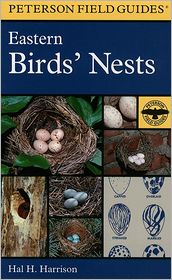

Barnes & Noble $20


Did you know that...
  • Robins use grass and mud to make their nests, but the amount of mud varies with the weather, from nearly all grass if the weather is dry, to full of mud, when things are rainy?
  • Great-crested flycatchers almost always include a snakeskin in their nest cavities? (No one really knows why)
  • A male Northern oriole starts his nest, a bag of woven grass that hangs high in a tree, and uses the beginnings of the nest to lure a female as a mate?
  • Tufted titmouses line their nests with fur, even plucking hair from unsuspecting animals as they go about their daily affairs?
  • Hummingbirds make their tiny nests from lichens and spider webs?
  • Bald eagles add branches to their massive nests each year, until the sheer weight of the nest, or bad weather, topples it?
  • Crows, normally raucous and boisterous, fly silently to their nests, to avoid detection by predators?
  • Blue jays like to weave colorful bits of trash and other "finds" into their nests?
  • Mourning doves create a disheveled nest from loosely piled twigs and leaves?
  • Turkey vultures lay their eggs on a bare rock ledge?
  • Towhees create a nest in a leaf-lined depression on the ground?


Our oriole friends hide their nest high in a tree -- Hurricane Sandy blew last year's down for us to study. (c) Kim M. Bennett, 2012.

7. Rock Walls

Living in New England means there are plenty of old rock walls around. The Puritans and other early European settlers found that planting and building anywhere in the Northeast meant dealing with the stones and boulders left by all those glaciers from the Ice Age. They placed these stones, called glacial erratics, in rock walls around their homesteads, where they remain to this day.


Rock walls teach about the settlement, and geology, of New England. (c) Kim M. Bennett, 2011


$16.95, Barnes & Noble
Stone Wall Secrets, by Kristine and Robert Thorson, and illustrated by Gustav Moore, is a beautifully illustrated book that teaches about the geology of New England, and the culture of the ubiquitous stone walls of the area. Author Robert Thorson, a geologist at the University of Connecticut, has been studying the stone walls of New England for decades, learning about the people who built them and the bedrock which created them. It's a great "go-along" for a fall study of stone walls. For more information on this book, click on the image, at left.


8. Mounds and Pits

In September, we learned about the "One Small Square" strategy, a technique for making observations about the plant and animal life, as well as the abiotic factors, in an ecosystem. This strategy can be used to examine the differences between two unique microecosystems: mounds and pits.

Mounds and pits are formed when trees topple over then decay, over time, creating a mound where the exposed root ball once was,  and a pit where it pulled out of the ground. These two areas often have different soil structure, and different plant and animal life. Autumn is a nice time to begin a study of mounds and pits, examining them when only evergreens are growing, and repeating the study on a monthly basis. Consider using the fall and winter months to map out fallen trees or mounds and pits, for future study. Practice using coordinates to map them out.


Mounds and pits form when fallen trees decompose. (c) Kim M. Bennett, 2011


9. Cones

This month, one of our studies involves comparing and contrasting evergreens and deciduous plants. Among the evergreens you will likely encounter in your studies are the cone-bearing plants, or gymnosperms. Cones make for an interesting nature study in the fall, as each type of gymnosperm has a unique type of cone, and the cones, themselves, change over time.

We like to collect pine cones from the white pines in our neighborhood, and make peanut butter and seeds feeders for our bird feeding station -- read about this in "Winter Bird Feeding."


Collect pine cones for autumn decor or making bird feeders. (c) Kim M. Bennett, 2011

10. Animal Tracks

Last week, we had our first snow storm of the season, when Storm Ari dumped 4-12 inches of snow over the state of Connecticut. Enjoying our first snow day, my youngest son and I went outside to re-load the feeding station and clean snow off things in the backyard.

We delighted in looking at the dainty little bird tracks in the snow on the hood of the gas grill, and the scuffle of prints over prints under the feeders.

Muddy ground or snow-covered surfaces provide an opportunity to study animal tracks. Check out "Follow Those Tracks!" for more information about tracks, scats and signs left behind by animals.


Study animal tracks by making plaster casts or taking photographs. (c) Kim M. Bennett, 2010

Share...

These are just some of the many studies we have been drawn to in the fall. We would love to hear about your fall finds, and the things that caught your eye as you explored outdoors this month.  Please make sure that you link up your blog post on the November Simple Science Strategies Blog Carnival.  Add a link to this post and the blog carnival in your blog post, too.

Have a great fall!


Saturday, March 31, 2012

Our March Bark Walk on the Nipmuck Trail-- and a Nasty Old Friend

I don't know what the weather is like there, but our month of summer weather, long nights under starlit skies, and shorts gave way to more realistic March weather for New England -- a dusting of wet, sloppy snow today.  Although it's not the 3" they were warning us about, and it really isn't cold, the snow was a reminder that we are, in fact, still in March, when just about any type of weather is possible.

A couple of weeks ago, we all took advantage of a beautiful Sunday afternoon, and took a family walk down to the Nipmuck Trail, part of the "blue-blazed" trail system established in many states. Because it  was too early for a lot of other spring changes, we referred to this walk as a "bark walk," and we took the time to quiz one another's plant ID skills based on buds and bark, alone.
--------------------------------------------------------------------------------------------------------------

 The Nipmuck Trail, Willington, Connecticut

Mr. B and I have decided that, being over 50, we need to be a little more assertive with our exercise program. Living so close to a well-marked trail system has distinct benefits. Hubby is recovering from a winter ankle sprain (I told him to tell folks he was Irish step-dancing or he had a rough landing while paragliding, but he simply missed a step while walking downstairs, and sat on his own foot -- being a rather large fellow, this was not a good thing). In my efforts to wait on him in the early days of his recovery, I, in turn, stubbed a pinky toe that I had broken about 4 years ago, rebreaking it. So putting on shoes, let alone hiking, was a big accomplishment on this day!

The blue trail head is clearly marked on our, and the volunteer parks and recreation crew (of which our eldest son, Evan, is a member) does a nice job of keeping the trail passable with minimal disturbance to the environment. The trail, itself, is clearly marked. You can expect to see a variety of spring wildlife in a normal spring -- our dry weather has seriously reduced the availability of vernal pools for migrating waterfowl and spring peepers.


-------------------------------------------------------------------------------------------------------------

An Unusual Spring...


The warm weather has caused all the buds to swell. All they need is a few days of wet weather, and they will just about burst.  The local daffodil festivals are worried about the earliness of warm weather, and suspect that the festivals will occur, without the flowers for which they are named, as most daffodils have been in bloom for quite awhile now.

The saucer magnolia at our house, which normally reaches full bloom mid-April, is already in full bloom.


We normally hike along the woodland trails more extensively, but Mr. B was terribly worried about stumbling on a rock or root, and undoing the fine progress that all of his hill climbing has done toward healing his injured ankle. We saved more rough terrain for another hike, and stuck to more level or paved paths for that day.

The Connecticut Forest and Parks Association has a website on the development, location and characteristics of the various trails in Connecticut's Blue-blazed Trail System. Our nearby trail also extends into Massachusetts. The majority of these trails are well documented, and you can find very specific descriptions of markers, paths, grade and intensity level for most of them. Our closest trail is ideal for families with small children, as it has little grade change, and, with the exception of a few climbs over fallen trees, is easy walking.

-------------------------------------------------------------------------------------------------------------

A Prehistoric Princess, and a Scientific Thought


The forest floor was carpeted with Princess-Pine, an evergreen plant which isn't really a pine at all, but is actually a clubmoss, a group of ancient plants that were around in the days of the dinosaurs. The cool, deciduous forests of Connecticut suit the needs of this plant very nicely, and it is a welcome bit of green-ness for early spring hikers, like us.

We just take pictures of most things we see as we hike. Princess-Pine grows from rhizomes, root-like underground stems, so attempts to pluck a sprig may end up uprooting an entire patch.

Folklore has it that lichens and moss favor the north side of a tree. I am not sure if this lichen was on the north face of the tree trunk, or not, but that sounds like a great experiment to do.


H(0): Lichens and mosses are equally abundant on the north, south, east and west sides of a tree trunk.

H(a): Lichens and mosses are more abundant on the north face of a tree trunk.

We would have to choose one kind of tree to study: remember, you want to control everything but the dependent variable (the abundance of lichens and moss). Likewise, it would be best to study in just one location.


-------------------------------------------------------------------------------------------------------------

The Bark Walk (and a Poisonous Surprise)


We had fun with this tree. My husband, who is learning a lot about plants, living with so many horticulturists in the family, recognized this as resembling a birch tree, and, in fact, he was right, as this is a gray birch (the shiny gray cousin to the more familiar paper birch, which is also prevalent in our forests here). My grandfather used to surprise us as children by going off into the woods with his pocketknife, to get special sticks for us when we used to toast marshmallows at camp. He always brought back these delicious, wintergreen-smelling wonders, which I now know came from the gray birch.

He used to also bake these little pies out of buttered bread and apple slices, in a special press that he held over the fire. When he passed away, it was one of the treasures that was passed along to me. I can't wait to use it this summer with my kids.


Connecticut's state flower is the Mountain-laurel, a cousin to the rhododendrons and azaleas. Here is a patch of baby ones. The mature ones should be flowering within the month: they flower before most of the rhododendrons and azaleas.

Our elder two sons are team leaders at a large wholesale nursery in the state, and have been busy packing and shipping mountain-laurels, rhododendrons and azaleas all over the country. Six a.m. starts and 7 p.m. finishes make for a tired young man.

Last summer, Mr. B was helping a neighbor get his yard in order. Being the helpful guy that he is, he volunteered for the tough task of subduing the hedges. I had told him to be careful of poison ivy, which I had noticed in the grass on the outside of the hedge. In the middle of the job, he called me over to remind him where it was. Sadly, he had already trimmed and weedwhacked it. Doubly sad was the fact that he had removed his shirt on this very hot day, and his body was flecked all over with the tiniest pieces of green, from the top of his head to the top of his socks. Every green speck found a sweaty, hot place to stick and hang out for a good long while, apparently, because he contracted the saddest case of poison-ivy that I have seen in a full grown man.

When we happened upon this next item, he asked about the hairy vine crawling up the tree trunk, and stepped far away when I identified it as his old nemesis, poison-ivy.

Now, in the fall, the poison-ivy leaves turn a beautiful maroon. Most folks recognize the three-leaflets of this sumac relative, but either don't recognize the winter vine, or don't suspect it as being as allergenic as the leaves. I once got a terrible case of poison ivy from raking dead leaves out of a farm cellar doorway. Being fall allergy season, I also must have rubbed my eyes and blown my nose, because I woke up the next morning and didn't recognize the woman in the mirror, whose face was as round as a full moon. Awful stuff. The roots, dried leaves and hairy vines are as bothersome as the green leaves, so be careful chipping wood that has vines growing on it -- you'll end up with a fine crop of poison-ivy in your flower beds. This also happened to us one year. More fun with poison-ivy!


This is an interesting picture. If you look closely, you'll notice a whorl of vines around this guardrail. Every guardrail was surrounded by the same whorl of vines. My husband remarked how odd it looked, and asked what kind of vine it was. I just started to laugh, and he said, "No way. You're kidding, right?" I was not.

Did you know that birds love the berries on poison-ivy? The non-descript flowers produce clusters of white berries, which many birds love. I constantly pull seedling poison-ivy out of my flower beds. I envision birds sitting atop each of these wooden guardrails, eating and pooping, and spreading a little poison-ivy love, all up and down the road.

If your pets like to roam the woods, be careful that you don't mistakenly pick up the oil from poison-ivy from their fur.

-----------------------------------------------------------------------------------------------------------------------

March Treasures...


By now, Mr. B's ankle was telling him to go back home (you can see that he had a trusty staff to steady himself at the end). Plus I think he had started itching, just thinking about the abundance of poison-ivy that he had seen on our March bark walk.

Malik had collected a sparkly quartz rock, Mom had snapped a bunch of photos, and the dog needed a drink of water (which a kind neighbor had ready for him when we made our way back down the road -- what a blessing!).

We stopped by a clump of forsythia to cut some branches to force inside. I added them to a vase of multiflora rose hips that I cut last fall (do you know that those rose twigs rooted? No wonder the plant is so invasive...).


The smallest member of our hiking crew still had enough energy for a tree climb later in the day. Mom & Dad relaxed inside, and the dog found his doggy bed to be a welcome spot for a little nap.

-----------------------------------------------------------------------------------------------------

If you want to do more research on poison-ivy, visit The Handbook of Nature Study for "Poison Oak, Poison Ivy and Poison Sumac: Leaves of Three!"

HNS also has a nice study of flowerless plants, such as mosses, ferns, and our friend, the Princess-Pine, in "What are Flowerless Plants?" Apologia has a free set of botany notebooking pages that you can use to record your observations of these, and other, plants

Spring is a nice time to begin a year-long tree study -- see Outdoor Hour Challenge, Spring Series #1: Year-long Tree Study, for details.