Wednesday, October 10, 2012

Signs of Autumn: Our Trip to the Orchard

[Submitted to the Simple Science Strategies October blog carnival and the Outdoor Hour Challenge blog carnival.]

We're Going to the Orchard!


No autumn is complete without a trip to the local apple orchard. We live near one of the nicest orchards in Connecticut, Buell's Orchard in a little town called Eastford, here in the northeast corner of the state.


Going to the orchard is always a treat. But, like I used to tell my third grader writers, it's better to SHOW the readers than to TELL them!  

(See if you can find all the signs of autumn that we observed... I'll list them at the bottom of this blog post)

Our Trip, in Photos


Rows and rows of trees, waiting to be picked.

The news folks are telling us that the apple crop will be smaller this year, because we had an incredibly mild winter (it really didn't snow, and it felt like early fall temperatures in January), which made lots of plants think that it was spring all winter, and the apples began to break about a month early. Unfortunately, this period was followed by a brief cold snap in April, which zapped many flower buds.

I can't really say that we noticed fewer apples, but, then again, when you're picking for yourself, you're only looking for a bag of them. I'm sure growers are noticing that varieties are running out earlier than they have.

When we went, they were picking Gala, Empire, Cortland and McIntosh. We (of course) had to get some of each.

The morning air had very crisp. so we brought our sweatshirts when we left for the orchard that afternoon.


Grandma enjoys the New England day.
We had an out-of-town visitor, my mom, who flew up from Florida to take care of me while I recuperated from thyroid surgery. This was my first outing after getting a little stir-crazy at home -- it couldn't have been a better one!

My mom doesn't get to pick apples like she did when they still lived in New York, so she specifically asked if we could go when she came up. Apples in the store in the South just aren't like the ones that you pick right off the tree. Heck, apples in the store in CONNECTICUT aren't either!

The temperature was warmer than we expected by afternoon, and we ditched our sweatshirts. We often are surprised by the wind that whips through the orchard, so it's better to be safe and have the sweatshirt, than cold and miserable.


Little Man was determined to pick his own bag.
Going to the orchard is one of our kids' favorite activities. Our oldest son had a soccer game, and the middle son had a social engagement, but the Little Guy is held captive by the fact that he is eight and doesn't drive!

He would have spent the whole day at the orchard. This year, he carried his own bag ("Because I'm a big boy."). An orchard trip is such a great family activity, because a fidgety kid can run up and down the rows (but not too fast, as he has to dodge apples on the ground), and there's free food wherever you go. Sunshine... outside... running... free food... play clothes... It just sounds like the formula for fun for little boys, doesn't it?

He dressed up especially for the occasion, in his favorite clothes: one of our tie-dye shirts from the summer, and his camouflage pants. Gotta love his style.


Want some apple experiments? Click here.
 We had a brief review of the apple-picking process: turn the apple like a doorknob so you don't pull off the branch; check it all around for holes and dents (don't take those); don't worry about the color (because the side facing away from the sun might stay green, even though the apple's quite ripe); fill the bag to the top...

I love the Galas for lunchboxes and snacks -- they are crisp, don't dent in the lunchbox as easily, and you can sometimes find these teeny tiny ones that are so cute and perfect. Just enough sweetness (they don't make your left eye squint, like Granny Smiths do to me! I know you know what I mean...).

The leaves on the Galas were spectacular -- this is what I envision when I see the word, "green."


There's Grandma... but where's the kid going?

On to the next variety: McIntosh. I explained to my son that Macs were good for apple sauce, but not so good for pie, because they turn to mush. I wasn't going to pick any, but I couldn't help myself. Besides, the apples all get mixed together in a "surprise" bag eventually.

One thing I love about orchard apples is they are so fresh, you can leave them out of the fridge and they still stay delicious for weeks. This always happens to me, since I always pick too many for my fridge to hold, and have to leave the bag out. [We made lots of Apple Brown Betty -- check out my recipe.]

It's been too warm to leave the bag outside. Besides, here in the country, there are lots of critters who wouldn't mind having a snack on the back patio, if we left them out.


I love farm life...

On the way to the Macs, we passed the garage where they kept the tractors. This one had been freshly hosed down, so we spent some time gazing at it. My eldest was a tractor expert as a preschooler, and had an incredible collection of Matchbox-style farm equipment. He could name all the brands, by sight: John Deere (this one), Farm-all, Caterpillar, Kubota...

The Little Guy was more interested in being independent, so we sent him back for four more Macs to fill up one of the bags. We gave him a brief on how to pick the best ones, and sent him off. He likes being asked to do jobs like that.

The pumpkin fields were just starting to be picked when we were there. I'm sure that pumpkin picking is in full force now. We told the child it was too early for a pumpkin. But I think a pie is calling me now...

Lots of bloom on this Empire.

As we looked over the apples, we noticed the differences in the varieties. The Galas had "feet" like Delicious varieties do, and a deeper red color (although not nearly as deep as Red Delicious), and the skin was a little tougher than the others (but not as tough as Red Delicious, again). The Macs were cute and almost totally round, and had more green on them. The Empires had the waxy bloom that rubs off on your shirt (love shining up an apple...). And the Cortlands were the biggest of all ("This one is HUGE!" exclaimed the boy.)


So is a Cortland as good as a Granny Smith?

We headed down the road to the orchard with the Empires and Cortlands. Empires are an in-between apple -- multi-purpose. My son was looking for his favorite Granny Smiths, but those are a later variety, and they weren't ready yet. I showed him the Cortlands, which are a good pie pumpkin, and explained to him that even though apple pie was sweet, you needed a tarter apple in order for it to taste just right. So he tried one, and declared it delicious (although Grannys are still his favorite).

I think that's so funny how little kids love Granny Smiths, which I find to be so sour, and they're not red. I wonder what it is?

I know that last year, when we were picking pumpkins, I let Little Man choose his, and he selected a cute green and white one. Not an orange one. Kids are funny.

You might have seen the photo to the right, on my "Favorite Photo Friday" post last week.


Crates ready for apple shipping.

There is something so "New England" about an orchard.

I took this photo of the storage facility, and when I looked at the photos back at home, I was struck by how much this resembles shots I have taken at the lobster docks in Maine. If you just glance at the photo, it looks like a big stack of lobster pots, doesn't it?

Whenever I think about moving elsewhere, I should look at this photo...


One more pass by the Macs before we hit the country store...

With our bags full (and already paid for), we loaded our apples in the car and headed to the store, to check out the fresh vegetables (I resisted the temptation to buy a Rubbermaid tub full of Japanese china that a gentleman was selling at a tag sale along the road -- I love dishes, and that can get out of control if I am not strong! I was...)

At the store, we bought fresh corn (FRESH FRESH corn), Italian frying peppers, orange and black bell peppers, and two "personal size" melons. Mmmm... We put the peppers to good use when we got home...

One more for the road...


Last fall, Little Man asked why orchard apples taste so good. I explained where we get apples here in Connecticut: fall are local, and tasty, winter are storage from here (not as tasty), spring are shipped from South America, where it is fall, and summer are storage from South America. I explained that stored apples lose some of the sweetness, and become a little softer and mealy. When apples come right off the tree, they are at their best.

He blinked at me as if I told him too much. So I summed it up: "Apples fresh off the tree still have the sunshine in them."

Do you know that is what he has remembered that all year? I love kids...


I am glad they don't weigh kids before and after they go to the orchard. Little Guy remembered that, last year, when he ate one of each variety (four then) he had a stomach ache. So he limited himself to three this time.

What Signs of Autumn Did We See?

Changes in the Weather

  • Chilly mornings and warm afternoons

Changes in Nature

  • Pumpkins ready to pick
  • Apples turning red
  • Apples on the ground

Changes in People

  • Jackets and sweatshirts in the mornings, t-shirts in the afternoons 
  • People going to pick apples and pumpkins
  • People making apple pies
  • Vegetable stands selling fresh vegetables
  • People visiting New England (for the changing seasons)

Did you find any others?


Updates...

We are almost ready to empty out the first batch of compost from our All Seasons Indoor Composter, and are very excited about bokashi as a compost aid! Stay tuned -- on around 10/15, the compost should be ready, and we will be blogging about our project!


All Seasons Indoor Composter, by UncommonGoods


Friday, September 28, 2012

Puffballs!

I have always loved puffballs.

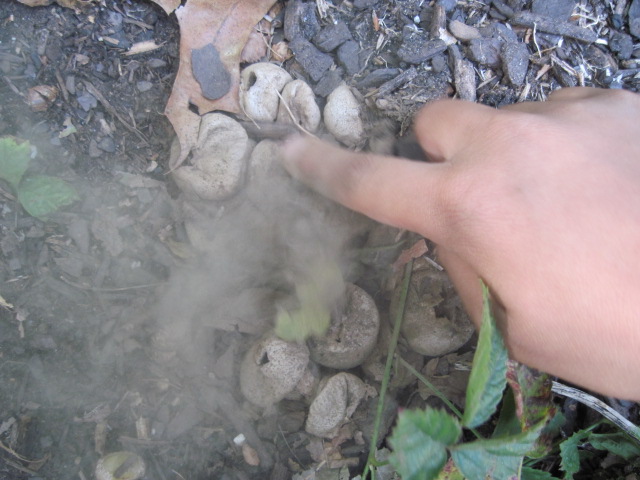
I don't think there's "too old" to have fun making puffs of "smoke" come out of a puffball. So when I spotted this patch of puffballs growing at the edge of the parking lot, a little childhood thrill went through my heart.


Puffballs, one of my favorite fungi (Photo credit (c) 2012 Kim Bennett)


What's a Puffball?

Puffballs are mushrooms that are shaped like a somewhat round "egg", that release their spores through a pore at the top of the "egg," when mature. They are attached to the ground by mycelium, as are the gilled mushrooms.

Puffballs can be confused with the immature forms of other mushrooms. However, when you slice the mushroom in half, a puffball will just be flesh (if immature, like this giant puffball my little guy whacked open on a nature walk last year [top]), or will be a hollow sphere full of spores (if mature, like the ones in the bottom photo, below).

Immature puffballs have just creamy flesh inside (c) 2010, Kim M. Bennett
Mature puffballs are hollow "shells," with only spores inside. (c) 2012, Kim M. Bennett

In comparison, if you slice open another type of mushroom, the cross-section reveals the shape of the mushroom-to-come:

In this photo, you can see the "buds" of a new crop of stinkhorns, alongside one that is emerging. You can see that the "shell" is a leathery or papery sheath that encapsulates the stem and head of the stinkhorn (see the remnants of the shell in the stinkhorn to the left). What you can't see in the photo is that the shell is also full of a nasty gel -- not easily confused with the contents of the immature puffball, above.

Stinkhorn "eggs," in cross-section, reveal the stinkhorn within, encased in a gelatinous matrix. (c) 2011 Kim M. Bennett

Gilled mushrooms, as well, reveal the upcoming mushroom in cross-section, as an "outline" of the major veins of the fruiting body. The Mushroom Expert has a great photo of a poisonous Amanita in cross-section, showing the outline of the mushroom within the egg.

Why Call Them "Puffballs?"

Puffballs do not have gills -- they don't look like "toadstools" with a stem and a cap. In contrast, their spores develop inside the capsule of the puffball. When mature, it takes only a puff of wind, the tread of a creature, or (better yet) the taps of raindrops to release the spores into the air, emerging from the pore at the top.

Of course, little boys (and their moms) can also help...

(c) 2012, Kim M. Bennett

(c) 2012, Kim M. Bennett
(c) 2010, Kim M. Bennett


Studying Puffballs

Puffballs make a great study for "One Small Square" activities, as there's a lot going on in a small area (check out the photos, above). Because they develop quickly, you can revisit the same spot quickly, over the course of a couple of weeks, and see things changing (good for working with little ones who need quicker change). Our crop of puffballs emerged and matured within a few weeks' time. Even after they matured, the shells of the puffballs remained for a long time, and were fascinating to my 8-yr-old, who always managed to get a few more spores out of them!

[Submitted to the Simple Science Strategies September Blog Carnival, and the Outdoor Hour Challenge September Blog Carnival]

Stay Tuned...

My All-Season Indoors Kitchen Composter (fueled with bokashi) arrived! Stay tuned for a review of this product (from UncommonGoods) in a couple of weeks (I'm very excited -- anything to stretch the gardening theme into the fall and winter...).

The All-Seasons Indoor Composter, $48 from UncommonGoods

Nadene at Practical Pages shares a hollow log indoor garden, complete with little honey mushrooms, that one of her children created for a homeschool learning project -- see it at "Freedom Homeschool Brings."


Will you help me out? 


Will you help me out?  Please click on the link below to answer a short, 8-question survey about your experience on my blog. No ads! Just information for me. Thanks so much!

Take the October 2012 Reader Survey  now.

Sunday, September 16, 2012

The "One Small Square" Strategy: Mushrooms and Other "Fun Guys"

Mushrooms love the woodchips in my flower bed.
[Edited and re-blogged from "A Child's Garden," September 2011]

We originally completed this study last fall, but are re-posting this for the September Simple Science Strategies newsletter, because it made good use of the "One Small Square" Strategy, the focus strategy for Week 3 of the September Newsletter, and focused on mushrooms, the topic for Week 2!


We sure have had some wild weather here in New England at the end of the Summer of 2011. We have had so much rain that the crop of mushrooms sprouting up everywhere has been very interesting and incredible.

Fall, especially the Back to School time, is always a prime time to go mushroom exploring, with the warm days, cool nights and more frequent rain.  Also be on the look-out for mushroom cousins, the slime molds and actinomycetes, that you probably mistake for their more well-known family members. Here is a mushroom study that you can do for September.

Before You Go Outside:

    Tiny shelf fungi on a dead tree, Fenton-Ruby Park and Preserve.
  • Read up on mushrooms. The Handbook of Nature Study has a very thorough discussion of many of the types of fungi that you might see on an expedition, on pages 714-727. If you read a little further, you can learn about their indoor cousins, the bread molds (pp. 727-728).
  • The Handbook of Nature Study website has an Autumn Outdoor Hour Challenge on Mushrooms that has excellent links to videos, notebooking pages and other resources.
  • Gather materials you might need for a mushroom study: clipboards and pencils, hand lenses, a long plant tag or flag to mark your mushroom spot, plastic food service gloves.
  • Read Outdoor Hour Challenge #9: One Small Square for a description of how to carry out the observation activity. 
  • Prepare observation sheets for each child. 
  • Review routines: "How to Work With a Partner."
  • Teach safety rules about potentially poisonous plants.

Honey mushrooms in a shady flower bed.
Observing Mushrooms and Their Cousins:

A mushroom study lends itself well to a multiple-day observation, since the fruiting body of most fungi only remains for a few days, and changes considerably with time and the weather.

Step 1: Note the location of some fungi on a nature walk.

Some places to look include wood chipped areas of a school flower garden or playground, rotting logs, tree stumps, and places where a tree once stood. At this time of year, a whole crop can pop up literally overnight, so don't be discouraged if you don't see any on a particular day.

Be on the lookout for the little "buttons" of some mushrooms that look like tan bumps before they sprout up the next day.

Step 2: Use the One Small Square technique to sketch what you observe.


Step 3: Mark the location with a stick or "flag" so you can find it the next day.

Step 4: Return to sketch changes for the next few days, until the mushroom collapses.

Mushrooms change very quickly from day to day, which is exciting for kids. Note the weather each time you observe (that day's as well as the weather from previous days). These observation forms have a place to record the weather.

Each day you observe, ask the students some questions:
  • How did your mushroom change? Why do you think this happened?
  • What was the weather like the day before? How might that have affected the mushroom?
  • What type of weather do mushrooms prefer? If you don't know, how can you find out?
  • Where are the mushrooms growing? What is the ground like there? Are there any trees around? 
  • Do you see any insects around the mushroom? What are they doing?
  • Does your mushroom have a smell? (Make sure that children don't handle the mushrooms without wearing gloves, because some poisonous mushrooms resemble harmless ones.)
Classroom Follow-up: 

Study the Anatomy of a Mushroom --
  • Enchanted Learning has a diagram of a gilled mushroom that students can label, to learn the anatomy of one type of mushroom.
  • The Mushroom Lady has a pile of activities that will get your kids really studying mushrooms in-depth.
 Learn About Mushroom Relatives --
  • Here is a handy sheet of terms that you might want to study, so that you correctly distinguish between fungi, actinomycetes, slime molds and other fungus-like organisms.
Study Edible Mushrooms (and Eat Them!) --
  • Create a mushroom study station with stereoscopes and various edible mushrooms from your grocer's produce department: shiitake, oyster, portabella, white button, straw, crimini...
Fairy Rings, Faerie Houses and Other Literacy Connections --
  • Study the folklore surrounding fairy rings and faerie houses.
  • Build a faerie house (or two or 10...) along your school nature trail or in your backyard garden.
Faeries and other woodland creatures -- literacy connection!

Will you help me out? 


Will you help me out?  Please click on the link below to answer a short, 8-question survey about your experience on my blog. No ads! Just information for me. Thanks so much!

Take the October 2012 Reader Survey  now.


Sunday, September 9, 2012

September Wildflowers in Connecticut - Our Sock Walk

As part of our contribution to the September Simple Science Strategies Blog Carnival, my youngest son and I put on our socks (over our shoes, of course!) and headed out to document the steps to a great sock walk. Malik videotaped, and I shot photos, and the two of us are currently trying our hand at compiling these into a video -- no telling how long this will take, but we will be sure to post it for you!

Our sock walk was along the edges of a mixed grass meadow that had been recently harvested, and across the cut meadow to a wet area that the farmer had left uncut. I think this is important, because the kinds of plants we saw on our wildflower walk are either common meadow wildflowers, or noxious agricultural weeds.


Field bindweed, Convulvulus arvensis

Common Name: Field bindweed
Scientific Name: Convulvulus arvensis
Family: Convulvulaceae (the morning-glories)

Field bindweed, or wild morning-glory, has beautiful flowers, but is quite a noxious weed in farm fields, due to the fact that it seeds so mightily, and its vines can grow to 18 feet in a season, overrunning large areas very quickly.

On the plus side, it pulls heavy metal contaminants from soils, and has been used to clean up toxic waste sites in Spain.


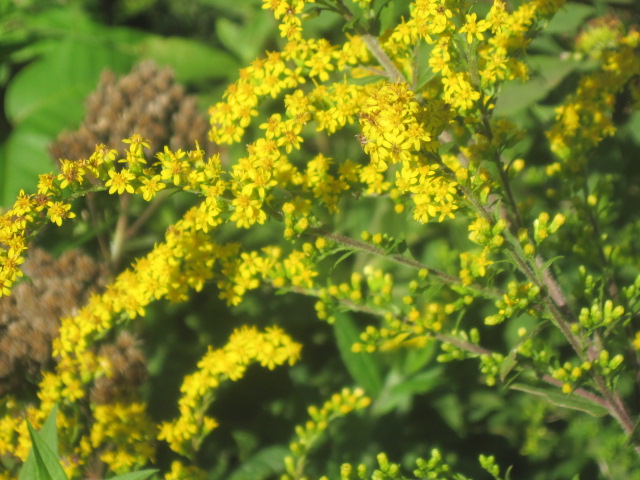
Tall goldenrod, Solidago altissima
Common Name: Tall goldenrod
Scientific Name: Solidago altissima

Family: Asteraceae (Compositae)

There are over 100 different species of goldenrod in the United States, so we had a little challenge identifying goldenrod species.

Goldenrod reminds me of the wildflowers that used to grow along the edge of the railroad tracks behind my house when I was little. Goldenrod makes a deep-colored, strong-
flavored honey.


Annual fleabane, Erigeron annuus

Common Name:
Annual fleabane
Scientific Name: Erigeron annuus
Family: Asteraceae (Compositae)

Fleabane, like goldenrod, has many different native species in the United States. You can tell them apart by the arrangement of the flower heads, and their overall habit, or use this online site for identifying fleabanes. Like other asters, fleabane is a great plant for attracting butterflies, as the adults feed off the nectar in this late-blooming flower, and the larvae find the leaves tasty.
 

Like most asters, this is a late-summer to fall-blooming plant, and provides much-needed food for butterflies and bees as the summer wanes.


Common milkweed, Asclepius syriaca
Common Name: Common milkweed
Scientific Name: Asclepius syriaca
Family: Asclepiadaceae

I love milkweed  (read a childhood story about milkweed here). It gets its common name from the milky sap that oozes from cut stems. Milkweed (along with other species in this family) is one of the favorite all-time foods of the monarch butterfly, with adults enjoying the nectar from the beautiful purple flower heads, and the larvae devouring the leaves.  

Find sources of milkweed seed here.

Rough-stemmed goldenrod, Solidago rugosa
Common Name: Rough-stemmed goldenrod
Scientific Name: Solidago rugosa ssp. rugosa
Family: Asteraceae (Compositae)

Side by side in the same hedgerow, I think we can find five or six different goldenrod species. Here is another representative from our sock walk this month.

Goldenrod has long been used as a source of natural plant dyes, creating a warm yellow color in natural fibers.


Oriental bittersweet, Celastrus orbiculatus

Common Name: Oriental bittersweet
Scientific Name: Celastrus orbiculatus
Family: Celastraceae

Bittersweet is one of those plants that people either love or hate. That is because there are actually two species that you find in New England: one is a wonderful, harmless native plant, and the other is an introduced species that has become quite a noxious weed, especially in hedgerows and reclaimed fields.

It is a perennial vine, but the bright red seeds that are exposed when the yellow or orange shell cracks open are loved by birds, and I think every one germinates, especially if it lands in recently tilled soil.

It is sometimes hard to identify the two bittersweets.  


White clover, Trifolium repens
Common Name: White clover
Scientific Name: Trifolium repens
Family: Fabaceae (Leguminosae)

White clover is another wildflower and meadow flower loved by autumn bees, and it makes a clear yellow honey much milder in taste than the deep-amber honey of the goldenrods.

Clovers  and other legumes are a common addition to forage mixes, and used to be added to grass seed for its ability to fix nitrogen.


Red clover, Trifolium pratense

Common Name: Red clover
Scientific Name: Trifolium pratense
Family: Fabaceae (Leguminosae)

Red clover, like the other clovers, is loved by bees and a common type of autumn honey. If you go to your local farmer's market or orchard to pick apples, you'll likely find a variety of honeys for sale: goldenrod, white and/or  red clover, and mixed wildflower honey are common. You might also find tupelo or other types of honey, depending on the plants available near the hives.

Some folks like to plant fields and other areas not easy to plant, with legumes, such as the clovers. They provide a source of food for bees, butterflies and other wildlife, produce color in an otherwise barren site, and improve the soil.

Meadow evening-primrose, Oenothera pilosella
Common Name: Meadow evening-primrose
Scientific Name: Oenothera pilosella
Family: Onagraceae

Like many of the other wildflowers in this article, there are many (over 120) different species of evening-primrose in North America.

The name, "evening-primrose," is hyphenated, because this plant is not a true primrose, the genus of which would be Primula. Evening-primroses get their common name from their flowering habit: the flowers close during the day, and open up in the late afternoon and early evening hours.

Some evening-primroses have a nice red-purple fall color, as this specimen from our sock walk.


Lanceleaf plantain, Plantago lanceolata

Common Name: Lanceleaf plantain
Scientific Name: Plantago lanceolata
Family: Plantaginaceae

When my eldest son was a little boy, he used to make elaborate cities in the garden, with building made out of sticks and rocks, and roadways for his Matchbox cars. He used to pluck the fruits off the seed heads of plantains, and fill a tiny trailer full of them, pretending they were ears of corn for the market. Too clever!
Plantains are good food to attract butterfly larvae to your garden.


Bishop's flower, Ammi majus
Common Name: Bishop's flower
Scientific Name: Ammi majus
Family: Apiaceae

Queen Anne's lace is a beautiful roadside wildflower. Unfortunately, people who have loved it enough to try to plant it in their yards have often regretted it. This highly invasive species will come up in farm field, flower bed, lawn or anywhere else with soil. Its tap root makes it difficult to rogue out.

Fortunately, there is an annual relative, Bishop's flower, that gives the same affect, seeds enough to establish as a wildflower, but not so much as to invade your entire yard.

Queen Anne's lace is useful for many homespun projects.


Common Name: Poison ivy
Poison ivy, Rhus radicans
Scientific Name: Rhus radicans
Family: Anacardiaceae

We recently went for a walk in the farm pasture, about two weeks after the hay had been cut. We were appalled at the very hearty crop of poison ivy that was coming up over the entire field!

Poison ivy spends most of its life as a vine, but, once mature, forms a shrub, and the birds just love its berries. Hence, the great poison ivy crop in a farm field. The leaves are brilliant red in the fall.

Poison ivy has many poisonous relatives.

Common ragweed, Ambrosia artemisifolia
Common Name: Common ragweed
Scientific Name: Ambrosia artemisifolia
Family: Asteraceae

I come from a long line of hayfever sufferers. Most of us chug through the entire year until about August 20 (here in the Northeast), when we all, suddenly, take ill. This corresponds, within days, to the start of the bloom period for this wildflower, one of the ragweeds. Common ragweed is one of the most common reasons for fall hayfever and allergies.


Big-leaf aster, Eurybia macrophylla

Common Name: Big-leaf aster
Scientific Name: Eurybia macrophylla
Family: Asteraceae (Compositae)

The wild asters are some of my favorite late-summer and early fall wildflowers. Like the garden asters, these bloom all summer, but really show their stuff at the end of the year, when other flowers have given up for the season. For this reason, I rarely rogue them out of my flower beds when they come up: rather, I selectively pull ones that stray from the group, and leave them as fall interest.


We collected a lot of different kinds of plant materials from our socks after our sock walk, including some seeds which we couldn't identify.  We decided to plant one sock (from each pair), but I regret to inform you that the intense rains we had from the remnants of Hurricane Isaac flooded our seed trays. This was great for birdbaths and water dishes for our cats when they didn't feel like coming inside. But it wasn't so great for a follow-up investigation. Better results next time, maybe?

Our investigation...


Oh, well...
That's okay... muddy water always tastes better, says Rosie.


We had a great time with tie dye this summer, using a commercial dye kit. But we have really wanted to try our hand at some natural dyes made from plant materials. Perhaps that will be our next tie dye project? Stay tuned...


Sunday, July 29, 2012

NEW! Botany Notebooking Pages for Fall...

[Re-blogged from Books and Blooms]

Right now, in New England, we've pretty much finished picking strawberries, and are now heading into blueberry season. It will be a minute before we will be out collecting bags of apples.

But I noticed at Wal-Mart the other day, that there are shelves and shelves of notebooks and lunchboxes on display, and I just got my son's school supply list from his fourth grade teacher, so can September be too far off?

For those of you preparing curriculum for the fall, come see my new science journaling pages.

"An Apple a Day" is the first in a series of science journaling pages that follows the  apple tree throughout the year. This first set focuses on the formation of the apple fruit from the flower.

The next set will focus on the fall colors of fruits and leaves.

For more information, see the Store at Simple Science Strategies.
See Simple Science Strategies for details!

Friday, June 29, 2012

Beaches, Beaches, Everywhere!

The Handbook of Nature Study's Outdoor Hour Challenge was beach-themed for the month of June. Here in New England, the water is a little chilly early in June, so we have waited (until now) to entertain plunging in (despite our incredibly hot air temperatures).

Big Clyde says, "Life's a beach..."
As we are planning for our first beach trip next week, we have been going over the things we have been studying in our other homeschool studies, and realized that beaches were in all of them!

  • The Swiss Family Robinson, our summer read-aloud, is taking us into exploration of life on a tropical island. I've been looking for my Hawaii photos to help us out... We are creating a theme basket which includes books on the plant and animal life on a tropical beach.
  • An independent project on WWII has brought us to Hawaii (yet again!), for a study of the bombing of Pearl Harbor in 1941...
  • Learning about the geography of Japan has been teaching us about islands as a land form, and beaches as part of the geology cycle.


In preparation for writing about our findings, I have begun assembling a Pinterest board with all kinds of links to nature studies and notebooking resources for beach work. Did you know that, if you Google "beaches notebooking," you get over 21,500 image hits? I am having great fun checking out what other beach lovers have shared. Given the number of projects we have underway that are connected to beaches, I'm sure that we will be visiting this board, and adding to it, quite often!


Here is a nature study from last summer based on a beach trip to Ocean Beach, New London, Connecticut, and a jarful of shark's teeth mailed to us from Grandma in Florida: Beachcombing, Part I: Shark Teeth. Stay tuned for Beachcombing, Part II after our beach visit next week! (We'll be sure to take our beach pages from the OHC with us...).


Other things on our list of homeschool activities for the week (and links we're using):

Friday: Watermelon Sorbet - we're in the middle of this one right now, as a garden/nature study connection to summer, beaches, tropical weather and all things June...
Saturday: Tie-dying - we bought a kit at Wal-Mart, and I'm gathering white t-shirts today for a weekend of colorful fun
Sunday: Continued work on our Child Training Bible
Monday: Pearl Harbor videos - for our history study of Japan and WWII
Tuesday: A trip to the library for books about Japan, WWII and Hawaii
Wednesday: Cherry blossom art - this is so cool (I'll buy frames and paints this weekend). I'm not sure how we'll exhibit the art, but here are ideas: Rainbow Family Room and Jewel Tones in the Living Room
Thursday: Not sure yet, but I'll look over my Making Math Meaningful board for ideas...


One of those days (or maybe two!) will definitely be a beach day, so we'll look over Life's a Beach for ideas after the trip, and save whatever we don't do for another day.


Don't you just love summer homeschool?

----------------------------------------------------


[This blog post is featured on the June 2012 Edition of the Outdoor Hour Challenge. Come check out other posts on bees, beaches, and other summer topics -- great ideas for summer nature study and homeschool work!]

Waikiki Beach, from www.aloha.com

Monday, June 11, 2012

What Color Attracts More Birds? - A Lesson on Fractions

 [Originally completed last winter, but submitted for the Simple Science Strategies September Blog Carnival 2012, because it shows how we connected science and grade-level work on fractions].

As part of our science work in Exploring Creation Through Zoology 1: Flying Creatures of the Fifth Day, my son and I recently completed a little feeding experiment (see Lesson 4).


Materials Used:
  • two identical pie pans
  • construction paper (one sheet of green, one sheet of red)
  • scissors
  • mixed bird seed (or seed of your choice)
  • 1-cup measuring cup
Procedure:
  1. Trace the bottom of the pie pan onto each sheet of construction paper; cut out the two construction paper circles.
  2. Place one circle inside the bottom of each pie pan.
  3. Measure one cup of mixed bird seed into each pie pan, making sure to push the seeds to one side to expose the color at the bottom of the pie pan.
  4. Place the pie pans on the ground in a place where birds frequently come to visit and feed.
  5. After 2 days, bring the pie pans inside. Measure the seed in each pan using a measuring cup.
Two identical pie plates, prepared for our color
preference study.


We used a premium mixed seed, but any seed will do.


We realized that the seed completely
covered the colored paper at the
bottom of the pan, so we pushed the seeds to
one side, to expose the color.


Our experiment is in place!


Hypothesis:
  • Null Hypothesis: Color will have no effect on which seed tray the birds eat from more.
  • Alternative Hypothesis: "I think that red will attract more birds than green." - Malik, age 8
Results:
  • When we measured the seed in each container, there was 2/3 cup in the red pan, and 3/4 cup in the green pan.
  • I had Malik use multiple methods to compare the two fractions, using the Rule of Four:
--------------------------------------------


Verbal Representation ("Words"):

Using words, Malik explains how he compares the two fractions. In his response, I can see that he correctly explains that the smaller the denominator, the greater the fractional piece, but he neglects to take into account the numerator is not one when responding. This shows me he understands what the denominator means, a big step for many kids.


Geometric Representation ("Pictures"):

I created a "Part:Whole" diagram, and asked Malik to show the fractional parts ("Divide the row into thirds/fourths..."), then shade in the number of fractional parts indicated by the numerator (the part he neglected in step 1, Verbal).

He correctly identifies that 3/4 is, in fact, larger than 2/3, but I can see that he has trouble eyeballing fractions when he divides the whole into parts.


Analytic Representation ("Patterns"):

Some math programs have students create a data table based on a "function machine," where one number goes in and another comes out. Sometimes the rule is stated; other times the child needs to discern the rule. This type of work forms the basis of algebraic thinking as the student gets older.

Here, I completed the data table for my son, and asked him to use it to answer the question, "Which is bigger, 2/3 or 3/4?" He was able to find the two fractions on the data table and compare them by comparing the equivalent fractions, 8/12 and 9/12.


Numeric ("Numbers and Equations"):

Lastly, I asked my son to compare the two fractions, in numeric form, using the conventions  of a simple inequality.

This was easy for him.

Heard from the other room as he was completing this task, "My hypothesis was correct!" (Don't you just love when little kids use big words correctly?) ;)


---------------------------------------

Reflection:


Malik showed a good understanding of the meaning of fractions in numeric form, and showed the ability to compare two fractions using multiple methods, especially using numbers and patterns, although he makes errors when drawing visual representations.

We will continue to work on the visual representation of fractions and part-whole relationships, and estimating fractions by sight, using volume and linear measures.

---------------------------------------------------------------

Our Other Feeding Stations:

A tube feeder with Niger thistle, to attract finches. We regularly get goldfinches and house finches to this feeder, as well as chickadees, titmouses and the occasional house sparrow, as well as nuthatches (white-breasted and red-breasted, brown creepers and the occasional downy woodpecker who manages to cling to the feeder).


The squirrels have knocked the perches off the sides, using the feeder as a way to jump to the sunflower seed feeder, but that doesn't seem to bother the little birds, who cling to the sides just fine.


Our bin feeder currently contains a black oil seed mix. We usually put a sunflower seed mix of some sort in this feeder. This feeder has been through the mill. It got knocked down by hurricane Irene, by errant football tosses, and my husband's head as he cut the grass. The leather strap that suspended it from the pole broke due to years of exposure, and has been replaced by countless things. I think we've hung it by an old shoestring now, using the suet baskets to tie it. The squirrels have a harder time opening the feeder now that I've tied the lid to the sides (it's hard to open the lid when you're sitting on it).


We always put out suet. We had many bluebirds this winter, with our mild weather here in Connecticut. We also find the set attracts woodpeckers (downy, hairy, red-bellied), nuthatches (white- and red-breasted), chickadees, catbirds and titmouses. The orioles have even passed through the yard. We sometimes make our own suet mixes. If you have an old-fashioned grinder, it's easy to make a suet mix. We have a recipe in another post. Not shown here is our hummingbird feeder, which I hung up after these photos were taken.

----------------------------------------------------------------

For more ideas for making math lessons fun for homeschool and classroom, see my Pinterest board, "Making Math Meaningful."